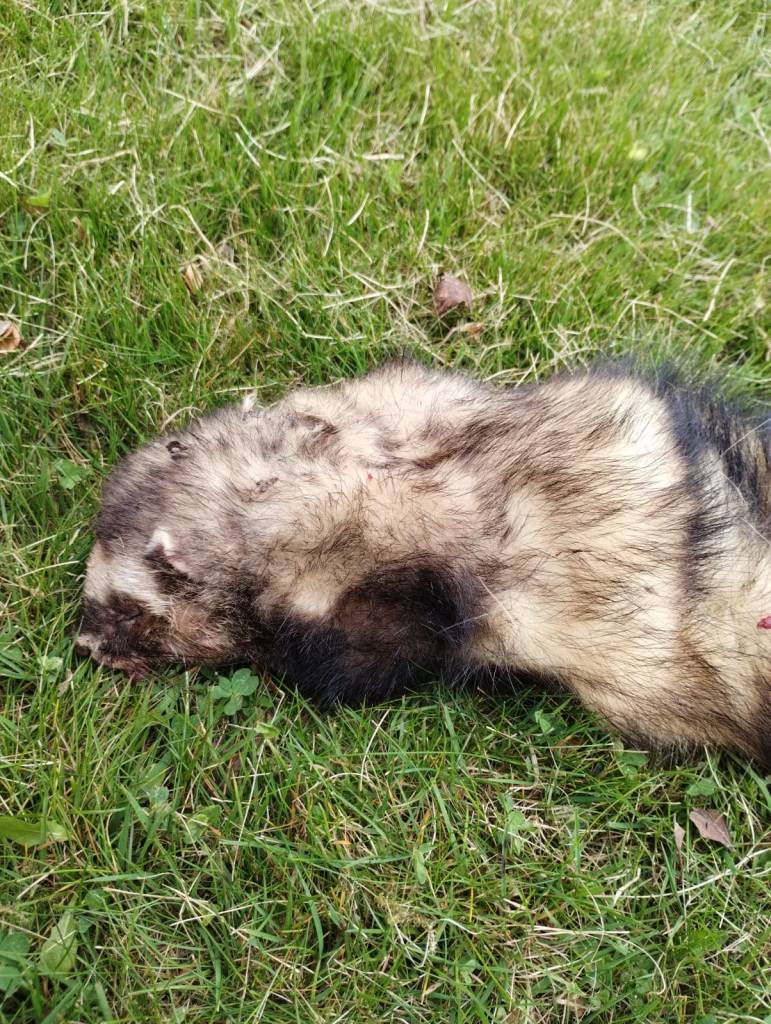
In late April, driving through Whiterashes towards Aberdeen, I noticed a roadkill animal on the other side of the road. At a quick glance, it resembled a Polecat. What does one do in such a situation? Throw it in the car, of course! So, following a bit of rush-hour traffic dodging, the animal was secured and double-bagged for later inspection.
The Polecat has a distinctive appearance, being well known for its black bandit mask across a paler face, though it is a hard species to monitor. This native species is the wild ancestor of domesticated Ferrets which can vary in appearance with some being entirely white but others closely resembling Polecats. Escaped or released Ferrets can establish wild-living populations of Feral Ferrets, especially on offshore islands away from competition from other medium-sized carnivores.
Polecats were previously widespread in Britain, but persecution led to them being restricted to Wales and a few others remnant populations by early 20th century. Subsequently, Polecats have spread to recolonise much of central and southern England with a a population in North-West England also recovering in numbers. Ferrets and Polecats interbreed freely, and the spread of Polecats may be aided by released or escaped Ferrets. Some animals show features suggesting mixed heritage and these are referred to as Polecat-Ferrets.
Feral Ferrets are well established in Shetland, but records of Polecats, Polecat-Ferrets or Feral Ferrets are uncommon in mainland Scotland. The Mammal Atlas of North-East Scotland and the Cairngorms featured 38 scattered records (between 1960 and 2015) none on which was verified as Polecat. More recently, an animal photographed near Fettercairn in 2020 appeared to be a Polecat, though it was reported as being quite tame, making captive origin possible.
The Vincent Wildlife Trust is running the fourth National Polecat Survey, through 2024 and 2025. If you see a Polecat, Feral Ferret or Polecat-Ferret, they would love to hear from you. If you have a photo (or camera trap image) then so much the better. Please let us at North-East Scotland Mammal Network know too.
As for the Whiterashes animal, closer inspection showed a paler pelage than typical of a classic Polecat, so it is best referred to as a Polecat-Ferret. The carcass is heading to Edinburgh Museum for use in research projects while fur and whisker samples are heading to Vincent Wildlife Trust for DNA analyses.
To take part in the National Polecat Survey (20204-2025) visit https://www.vwt.org.uk/projects/national-polecat-survey-2024-2025
Nick Littlewood
NE Scotland Mammal Recorder
 North East Scotland Mammal Network