
This is the second in a series of planned articles by local zoologist Annie Lamb, looking at what our mammals are up to through the year. Check back here for future articles…
Mammals cope with the coming of winter in a variety of ways. Some are preparing to shut down and let winter happen without them. For others it’s the opposite—October is a passionate time. Some solitary small mammals become rather gregarious, while others, though already very small, grow smaller.
Red Deer
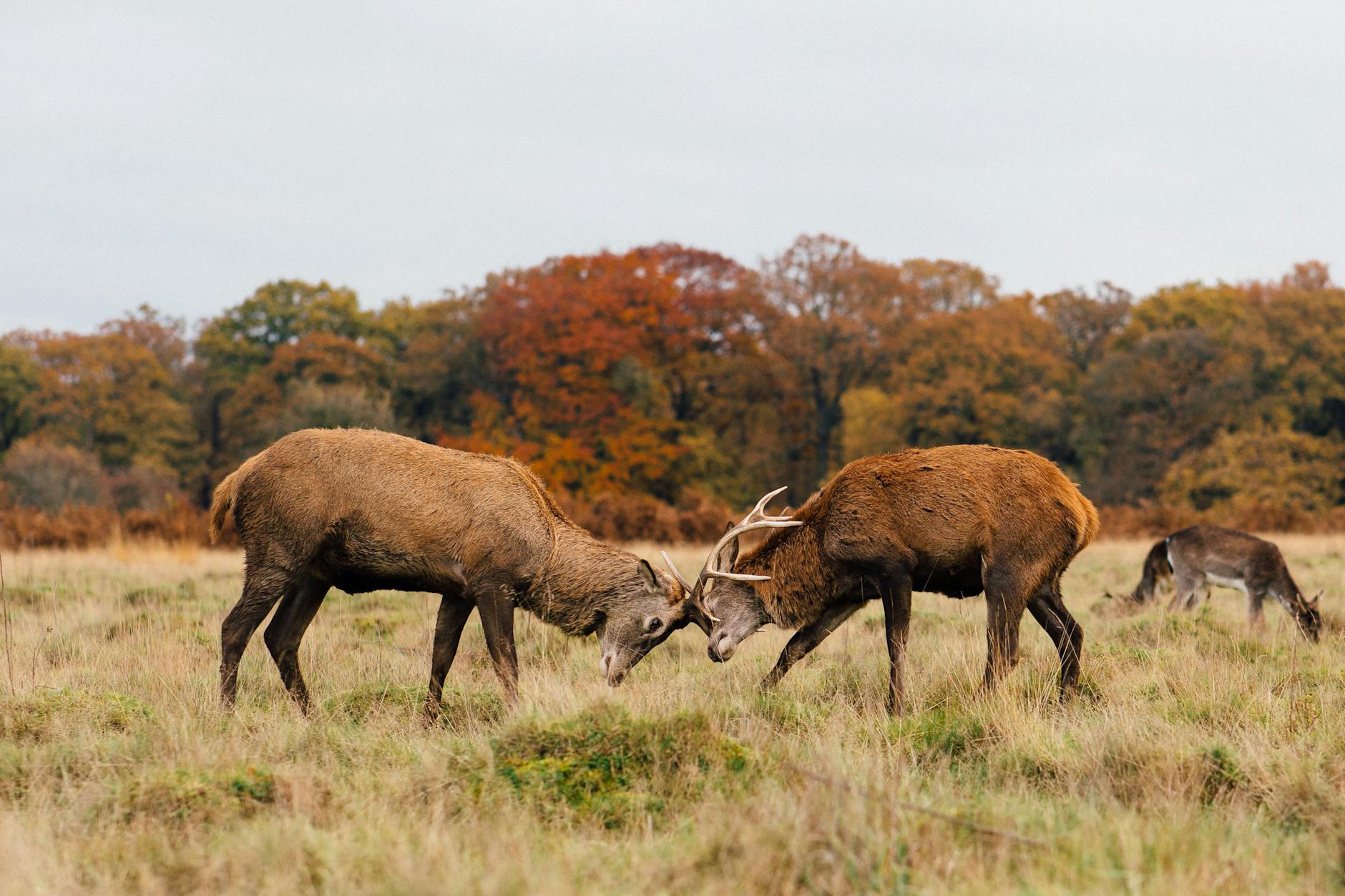
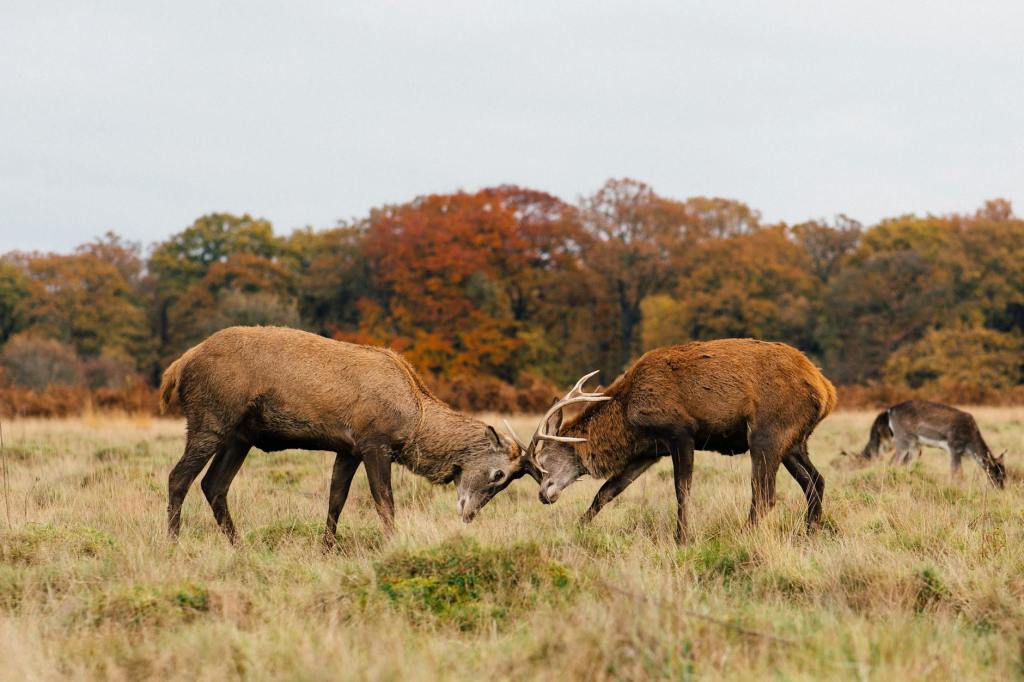
For Red deer (Cervus elaphus) stags, this is rutting time. Our other two large deer species, Sika (C. Nippon) and Fallow (Dama dama), also rut in October, but are rarely seen in the northeast.
The rut is a time of intense effort for sexually mature stags, as they keep control of a group of hinds and so ensure access to matings. The so-called harem may be seen as a herd of hinds, with a few young males, that the stag has joined up with as they move and feed. Now he must try to exclude other stags and exert himself, as well, by mating with hinds. He maintains his dominance by roaring, by flourishing his antlers and by constant vigilance against challengers.
At this time of year, the stag’s antlers are polished hard bone, and they’ll be his weapons when challenged for his hinds. Mature stags without access to hinds will roar at him and engage him in head-to-head wrestling, called ‘locking antlers’ (luckily for the animals, actual locking is rare). This contest shows up the weaker stag, who may turn away—often to rush back into the fight with a probing stab at his rival.
Battles like these go on hour after hour. They are not fights to the death, but all these stressors packed into a brief time are thought to contribute to the relatively short life expectancy of stags. After the rut is over the stags band together into an amicable single-sex herd.
The rut is a spectacle that draws human observers. You might visit the Cairngorms National Park, which has many Red deer, specifically to watch their dramatic behaviour. When doing this you should not bring your dog; you should keep your distance from the deer, in case a stag sees you as a rival. If you were a stag, the two of you would begin to duel by pacing alongside each other, parallel and facing front but with sidelong looks that show the white of the eye. In this situation your rival may weigh 225 kg and you are at risk. Back away, the British Deer Society suggest; don’t run and try to get behind something solid.
Hedgehog

Hedgehogs (Erinaceus europaeus) usually begin hibernation in October, although in mild autumns they may be active into December. Hibernation lasts until March or April but is not necessarily continual. During mild spells, you may see a hedgehog foraging as it moves from one nest site to another. In autumn, they gather dry leaves to make a nest, which may be under a leaf pile or brush pile, in a compost heap, under the wood stack or the shed or in a purpose-built ‘hedgehog house’ you may have supplied.
There are organisations dedicated to hedgehogs and their care. Hedgehog Street has some advice for concerned humans. For instance, if you put out supplementary feed for your hedgehog it’s especially helpful to do so in late summer and early autumn, because the animals are laying up fat for hibernation then. You can also make dry autumn leaves available. In winter, if the weather turns mild, you might put food and water out, but not too close to the nest (a couple of metres distant) in case of attracting a predator. Water is important, since the hedgehog gets much of it from its prey and there might not be much prey about.
Hibernation isn’t sleep, but torpor, which the hedgehog achieves by dropping its body temperature. Torpor can be profound enough for the hedgehog to seem to be dead. But if you stroke the spines very gently there should be a slight ripple of response if it’s alive.
However, if you find a hedgehog in torpor it’s vital not to wake it up. This would deplete its reserves of energy which it cannot win back. Its bedding should not be disturbed either. But all these problems are yet to arise—your hedgehog is only just settling down in October …
That bonfire you were going to light next month? Maybe you shouldn’t.
Grey Seal
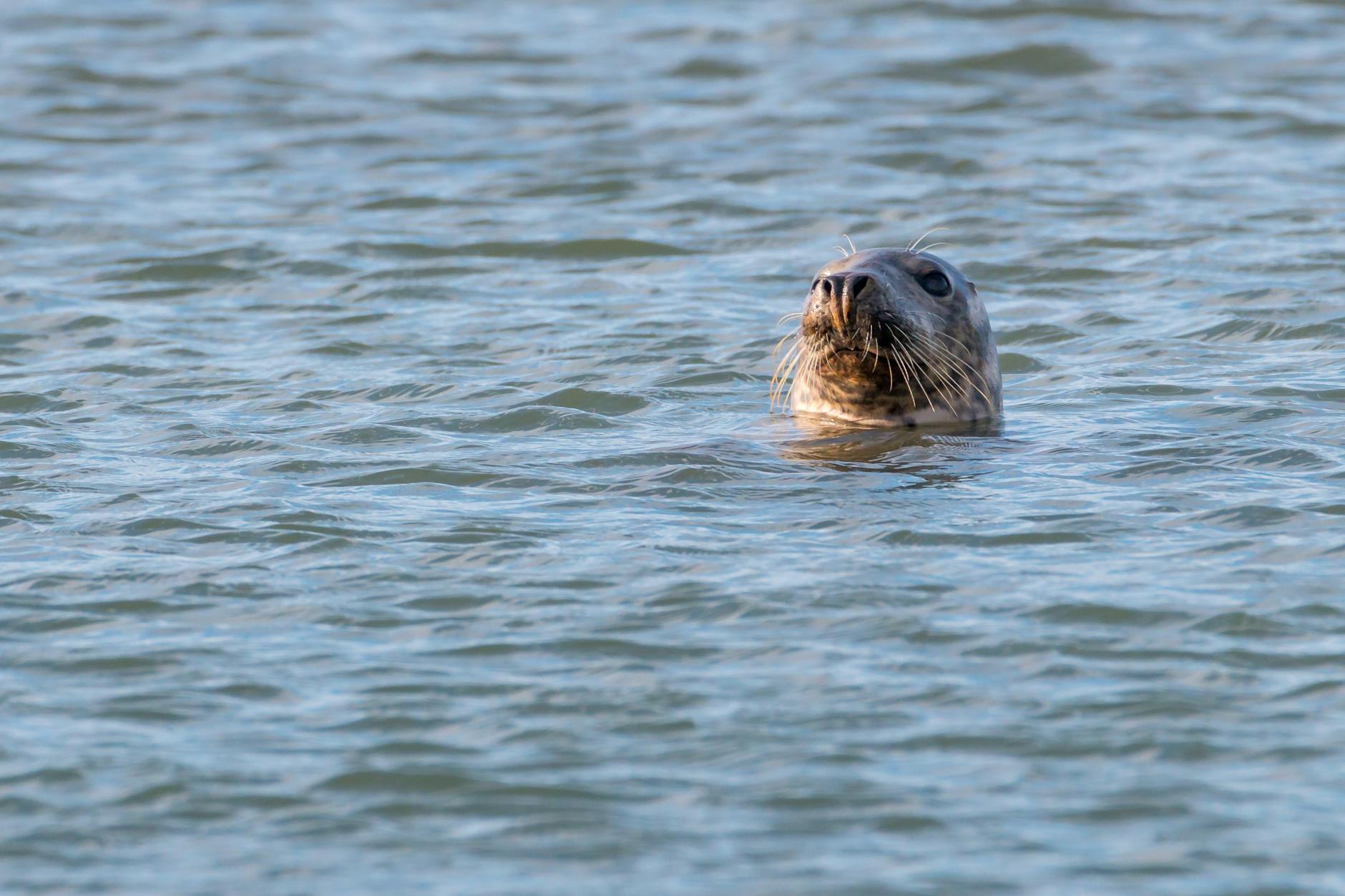
For Grey seals (Halichoerus grypus), autumn is a whirlwind of pup-bearing, mating and general strife. The month for these events depends on latitude, with more southerly populations pupping earlier and northern ones later. For example, in the Ythan Estuary, Ythan Seal Watch predict that pups will start to be born near the end of this month, whereas on the west coast of Scotland October seems to be the main month for pupping.
Female Grey seals come ashore at their own natal haul-out sites to give birth. They favour smooth, sandy beaches, and this is where most pups are born although the mother may go up into the dunes a little way. (According to Marine Scotland, pups may be born on a rocky shore.) Birth appears to be easy, the pup slipping out quite quickly, but you’ll see and hear at once where it has happened from gulls fighting over the afterbirth. The new pup weighs 14 or 15kg (while its mother is only around 155kg) and during lactation it will gain 2kg a day. Seal milk is 60% fat, more a glop than a liquid and very nourishing, which means that the pup reaches four times its birth weight in the swift three weeks of lactation. When lactation is over, the mother leaves her pup to fend for itself; if by then it hasn’t grown big enough, it probably won’t survive.
The pupping beach is also the site of mating. Males come ashore and seek to control a harem of up to ten females. These seals show extreme sexual dimorphism. Grey seals in general have a long head and Roman nose (this distinguishes them from the more doglike Harbour seals) but the fully grown male Grey seal has an unmistakeable hooter; he’s also a good deal larger than the female at an average weight of 233kg.
Much like the stags, bull seals at breeding are either in possession of females or seeking to depose some successful bull from his harem. The bulls fight to hurt one another, unlike stags whose battles retain some ritual. Dominant bulls (‘beachmasters’) are unsurprisingly the biggest and are at least 10 years old.
There are many spots for watching Grey seals in our area. They haul out in the Moray Firth, at Findhorn for instance and at the Old Bar. It will be worth looking there this month and the next. At Sands of Forvie, pups are born on the north bank of the estuary.
But, when looking at breeding seals, avoid causing any disturbance. This is best done by staying at least 50 metres away, never getting between a mother and her pup, and keeping your dog on a lead, if he must be there. One serious danger of disturbance is that it can cause pups to die, for the pup needs to suckle throughout those three weeks to gain weight for its imminent independence.
Wood Mouse and Bank Vole
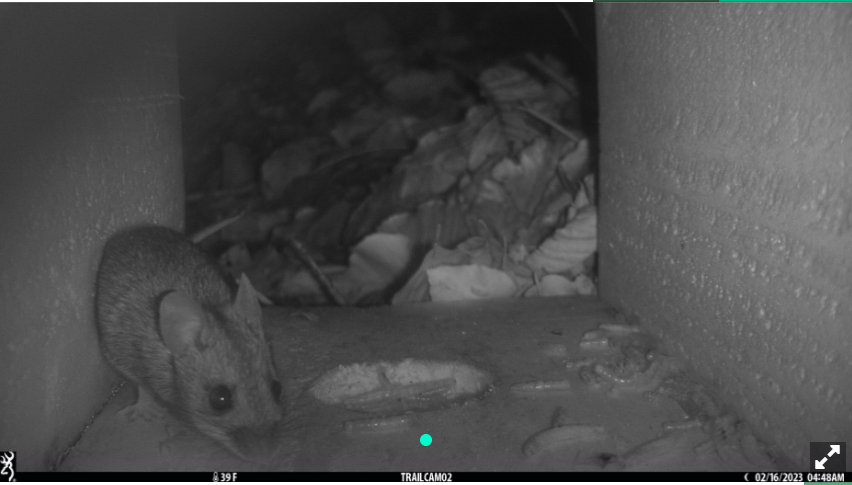
Locally, Wood mice (Apodemus sylvaticus) are the mice that share our houses. It’s true that the House mouse is sometimes seen, and if you have mice in the summer they could be those. But some Apodemus routinely move indoors in October. Towards spring, the influx will normally cease.
October is the end of the mouse’s breeding season. Now, assuming it’s living outside, it will improve its nest with extra materials and possibly block up the entrance with twigs, stones and leaves. The mouse’s caches of food such as seeds and cherrystones will become increasingly important with the season. Females become more tolerant of one another, and are able to share a nest.
The mice caught so far this October have been mostly juveniles, with the occasional adult. Juveniles are not only smaller but greyer, with a uniform dun-coloured fur on the back. Adult pelage is more cinnamon shading to a much darker dorsal area. Presumably the juveniles were born in early autumn or even as far back as August, and are dispersing now.
Bank voles (Myodes glareolus) are also coming indoors. They are good climbers, hence usually they’re caught in the attic. These individuals, like the mice, appear from their size to be young. The voles who remain outdoors will survive (if they do) by burrowing and eating roots and other food found below ground. It’s probably their fossorial life style that brings them indoors in the first place as they have been seen in summer slipping in under the bottom course of the house wall.
Common and Pygmy Shrew
Common shrews (Sorex Araneus) and pygmy shrews (S. minutus) are conspicuous for shrinking in winter and, assuming they make it to spring, regaining their earlier size. They share this ability (Dehnel’s phenomenon) with weasels: it’s said to be a property of very small predators of high metabolism, which survive winter better if they require less fuel to keep themselves going.
The decline appears to be measurable from August onwards, driven by falling temperatures. By October the shrinkage is well along towards its January minimum. The reduction in mass involves not only a change to the body size (in which, for example, the length of the spine decreases), but a shrinkage of the brain and skull. The brain is metabolically demanding, and it may be targeted especially because whatever energy the shrew can gain must be diverted to simply staying alive. The brain’s regions differ in their response to shrinkage and re-growth: for a really comprehensive analysis of the phenomenon in S. araneus see Lázaro et al, 2021, Ecology and Evolution 11(6):2431–2448: 10.1002/ece3.7238
When spring comes, surviving adult shrews may double their winter body weight. Their increase in size is linked to reproduction, with corresponding changes to various parts of the brain.
Annie Lamb
Annie is a zoologist and wildlife recorder. She has run a camera trap in the region for the past ten year.
 North East Scotland Mammal Network