
For mammals that don’t hibernate, this month brings changes. New activity patterns arise. Some animals grow a white coat and adapt to the chance of snow in other ways. Some species already seem to be looking towards spring.
Harvest Mouse
Harvest mice (Micromys minutus) may have been under-recorded in the north-east. The Mammal Society ran a National Harvest Mouse Survey (NHMS) between 2021-22 and 2024-25, to try to determine the numbers and distribution of the mice across the UK. Harvest mice are potentially at risk from changes in agricultural practice, and from climate change that may lead to flooding of their habitat. But without more detailed knowledge of the population, their conservation status can’t be assessed.
NESBReC currently holds one record, from Scotstown Moor, Aberdeen in 2020 whilst a nest was found at Blackdog last year during a survey by the North East Scotland Mammal Network. The NHMS found a nest to the far west of the area as well. But other nests have been found in the north-east, for instance beside the River Isla. So the species could be fairly widespread, though cryptic.
Now is the time to survey for nests. The autumn weather has thinned the vegetation that hid them during summer. The nests, which are made of living grass tissue, are now unoccupied. The larger tennis-ball-sized ones were built for breeding. Throughout the summer one female uses a new nest for each of a series of litters. Males and females associate only when breeding, the male taking part in nest construction but leaving when the female grows aggressive towards him.
The harvest mouse survey also records the sleeping nests built by non-breeding individuals. These, too, are made among grasses and built out of living tissue, but they are smaller than breeding nests (more like a ping-pong ball), being less thickly lined.
After the breeding season is over, harvest mice may make ground-level nests of shredded grass, or build them in thickets and hedges. But their most notable refuges are places where fodder and grain are stored over winter. The unlimited store of food can bring very large numbers of mice together. As with some other small mammals it’s the females that tolerate company; as well as associating in winter, they allow their summer home ranges to overlap. In contrast, it seems the males avoid one another.
The name ‘harvest mouse’ suggests a diet of corn, but in summer and autumn the mice eat insects and fruit as well as seeds. Their impact on standing crops is said to be small, while on the other hand they destroy insect pests.
Mountain Hare
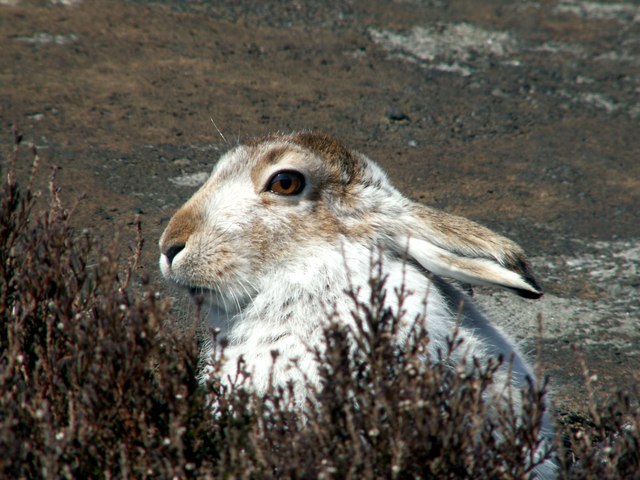
This month, mountain hares (Lepus timidus) begin to turn white, although their ears, and often their noses, remain brownish grey. The full winter coat is not only white but relatively long and thick. On the hind feet it grows especially fluffy, effectively creating snowshoes.
As the hairs of the winter coat grow in, the darker hairs of summer are replaced by white ones. These hairs are unpigmented; the production of melanin by the follicles has ceased. At first, and in spring as the white hairs are moulted, this gives a mixed coat that resembles a background of patchy snow. To an observer it seems that the colour change keeps pace with the season to match the hare’s surroundings. This is true only when winter proceeds from lighter to heavier snow, which isn’t always the case. And often the hares remain white in early spring even though the snow has gone.
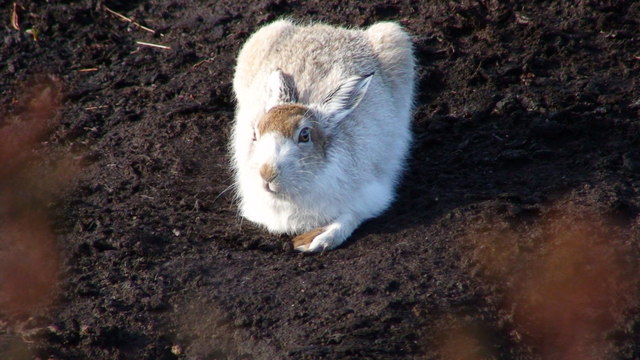
Environmental factors trigger the change to white. It’s said to be, in part at least, a response to changing daylength. Since this doesn’t necessarily mean it will snow, a white hare can be conspicuous even in winter. Some authorities say that temperature is the environmental cue for turning white; again, if the weather turns cold but it fails to snow, the hares are quite visible. Open winters have become frequent because of climate change, which might put the hares increasingly at risk.
When there’s snow cover, groups of hares will collect on sheltered hillsides where they can dig through the thinner snow to forage. Such a gathering might include as many as 20, especially when they are numerous: their populations show a ten-year cycle, increasing from trough to peak by a factor of ten or more. Mountain hares move and feed by night, so at times there might be 20 hares quartering the hill in twilight. They are found on higher ground in the western part of our area: the Cairngorms, Grantown, Dufftown, and western Deeside.
Stoat and Weasel
Like mountain hares, stoats (Mustela erminea) grow a white winter coat. The full white coat is said to be a northern phenomenon, most often seen in Scotland rather than England; stoats living in the north of England may develop an intermediate winter coat, partly white, and partly russet brown, but always with the black tail tip of an ermine.
In this country, weasels are brown in winter. However, the weasel’s scientific name is M. nivalis, or ‘snowy’. This could be because in northern Europe, where Linnaeus (who named the species) lived, weasels turn white in winter. The species is found in the New World, where some weasels living surprisingly far south also turn white.
Research shows that, while the animals change their coat in response to shortening days, this hormonal response is genetic. Some populations have the necessary gene and others lack it. There is some concern that as the climate warms up, decreasing photoperiod will cause weasels with this gene to be at risk in winters when there is no snow; in experiments, white weasels on dark backgrounds were found to be predated more (though they weren’t real weasels!). New World M. nivalis are separated into subspecies, some of which are expected to go extinct through replacement by neighbouring subspecies that don’t turn white in winter.
As with weasels, the colour change in stoats seems to depend on their genetic make-up. It’s thought that the gene for a full white coat is conserved by northern populations. Since the stoats of Yorkshire grow a partly white coat, rather than a plain brown one, the genetics of the response to daylength are likely to be complex.
In our area the stoat sightings recorded by NESBReC are sparse compared to records of pine martens, for instance. But they’re widely distributed and might be encountered anywhere. Possibly we should look for them in places where there are plenty of rabbits, a favourite prey.
Red Squirrel
For red squirrels (Sciurus vulgaris), this month brings changes. The males are coming into breeding condition: this means that their testes have descended and are growing. The males have begun to look for chances to mate. Beginning around midwinter, the squirrels’ mating activity will intensify, with wild, noisy chases around and between the trees.
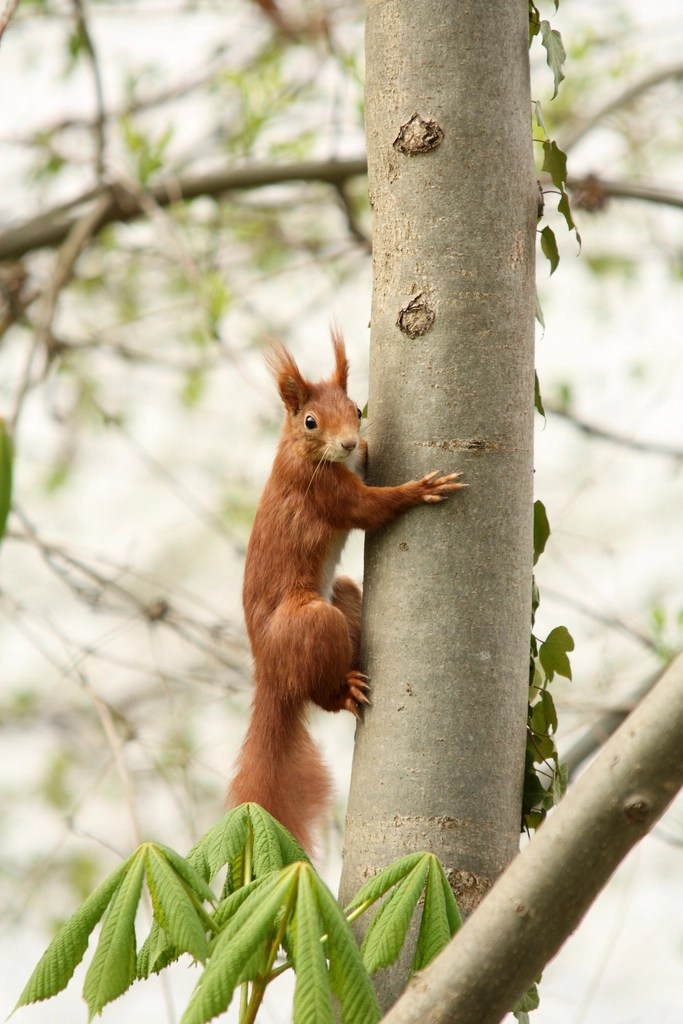
Their daily activity cycle takes on a winter pattern, seen from November through January. At other times of the year, squirrels have two daily peaks of activity with a quiet spell in between. Although they get up in the morning, it’s not necessarily at dawn. In contrast, the winter pattern shows a single activity peak. Now the squirrels emerge at daybreak, and retire to the nest around 2 pm or even earlier. Activity seems to consist largely of seeking food. The range of foods that squirrels can find in winter is comparatively limited. Apart from items they cached in autumn, it may consist of pine seeds and not much else. But this depends on where the squirrel lives. Among pine trees, cones are always available, and beech woods will still yield beech mast. If the squirrel has access to hedgerows and gardens it will find rose-hips and other tree fruits that linger, uneaten, throughout November.
Then there is tree bark, which some squirrels make a habit of stripping and eating. Trees seem to be more attractive as food the more sap the bark contains. So we’d expect bark to be more important as the sap starts rising, and this, presumably, will happen later.
By now, squirrels have moulted their red summer coats, and replaced them with winter ones that are thicker, softer, and darker. Another change to the pelage is the growth of ear tufts which will become conspicuous by midwinter.
Beaver
Thanks to a reintroduction by Cairngorms National Park Authority, there are beavers (Castor fiber) just outside our area and we may see them by visiting the Beaver Trail at Rothiemurchus.
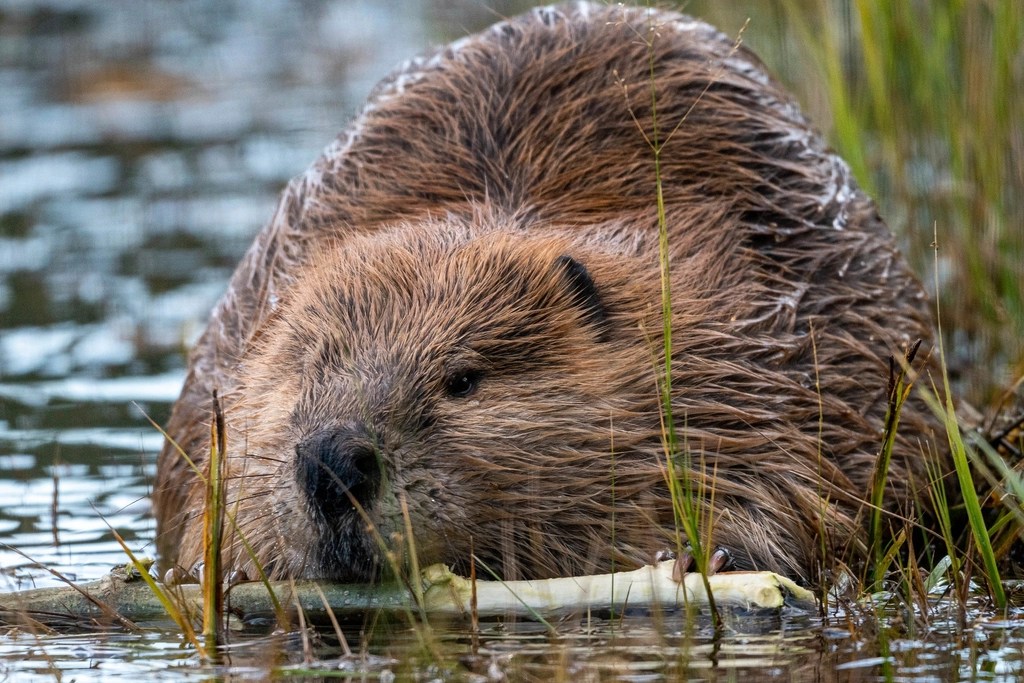
In November, as it grows colder, beavers build or re-build their lodges. When they’ve settled in a territory a pair of beavers will probably build a lodge within it. If not a lodge, they’ll dig one or more burrows in the river bank. According to the project report, the Cairngorms beavers have managed to establish nine territories, with eight found to contain lodges or burrows.
With time, each pair’s territory will be home to an extended family group. Beavers of all ages engage in lodge building and in dam repair. They’re said to respond to the sound of flowing water, which helps pinpoint the leaks in a dam. The sound of water probably stimulates work on the lodge at this time of heightened flow, and of increasing building activity.
Roe Deer
According to trail camera records, roe bucks (Capreolus capreolus) shed their antlers during November. These will re-grow very fast, so that you’re likely to see bucks in velvet early in the new year.
Annie Lamb
Annie is a zoologist and wildlife recorder. She has run a camera trap in the region for the past ten year.
 North East Scotland Mammal Network