
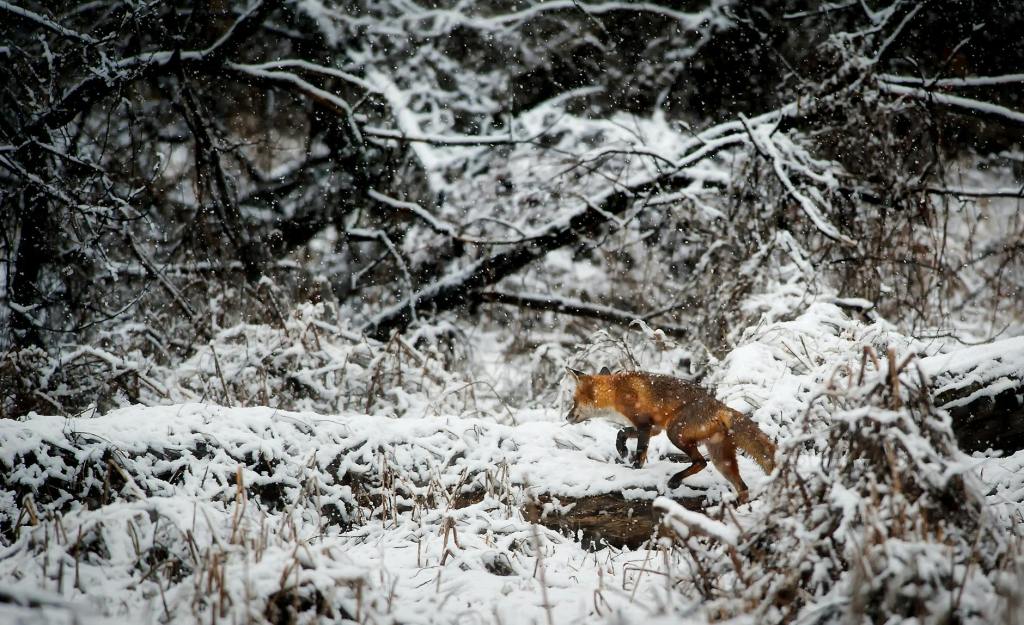
Frost and snow aren’t as common with us as they used to be. But the mammals’ adaptations to winter remain, and will protect them in case of a prolonged frost. Besides, up on the Cairngorms plateau the conditions may be as harsh today as they ever were in times past. Meanwhile in more sheltered spots, the longest nights bring significant changes to mammals’ lives.
Reindeer
The familiar silhouette of Santa’s sleigh passing across the moon shows the reindeer, Rangifer tarandus tarandus, proudly antlered as they pull the sleigh. Otherwise the image wouldn’t look like reindeer. But Christmas is the time when reindeer start to shed their antlers. The new ones will grow quickly, so that they’ll be hard and strong and in many cases huge, by the time of the rut next September.
Since there’s a herd of them in the Cairngorms, reindeer make our area somewhat special at this season. The Cairngorms reindeer herd was established in 1952, with seven animals from Sweden. The free-ranging deer do well on the plateau, watched over by a team of herders, but largely taking care of themselves as the conditions and forage suit them so well. Each December, some of them come to Christmas events in various towns. Ideally they’ll turn up to these fully antlered—this is possible in December, because not all of them shed at the same time.
Both reindeer sexes have antlers. Among deer species, this occurs only in reindeer and caribou R. tarandus granti. Many authorities assign reindeer and caribou to R. tarandus, distinguishing them with the subspecific names; others say they are the same species and leave it at that. Still others separate them completely, so that caribou become R. arctica, for example. Caribou are migratory whereas reindeer are not—though it seems there are exceptions to this.
Antlers are thought to be shed under the influence of testosterone. Pregnant females, who will calve in the spring, keep their antlers through winter (which suggests that it’s not just testosterone, but its balance with other hormones). Some writers say the females retain their antlers to maintain dominance while eating for two; others say it’s to help them dig for food in the snow. But all reindeer use their feet for digging in the snow. The cleaves of the hoof are concave and form scoops.
Reindeer feet are part of a suite of adaptations to life in snow. The cleaves tend to splay out when trodden on; the dewclaws also contact the substrate, spreading the animal’s weight like snowshoes. Above the conspicuously hairy feet, the legs are thinly covered with hair. The rest of the body is thickly furred, keeping the core temperature steady, but the legs are allowed to stay cool, helping to prevent body heat from radiating out into the cold. In contrast, the silvery winter coat of a reindeer is so thick that the deer can lie down to sleep on the snow and not melt it.
Much has been made of Rudolph’s very shiny nose. Real-life reindeer have rather bulbous snouts which only need a little lipstick to get that look. The nose is big because, inside, there’s a lot of folding of the mucous membrane, greatly increasing the surface over which the deer’s breath passes. The heat of the warm outgoing breath is recovered by the small blood vessels of the mucous membrane, which are cooled by the incoming air. So a lot of the heat is retained. It’s said that in cold air, when your breath is steamy, the reindeer standing next to you will breathe out no steam. His breath isn’t especially warm.
Foxes
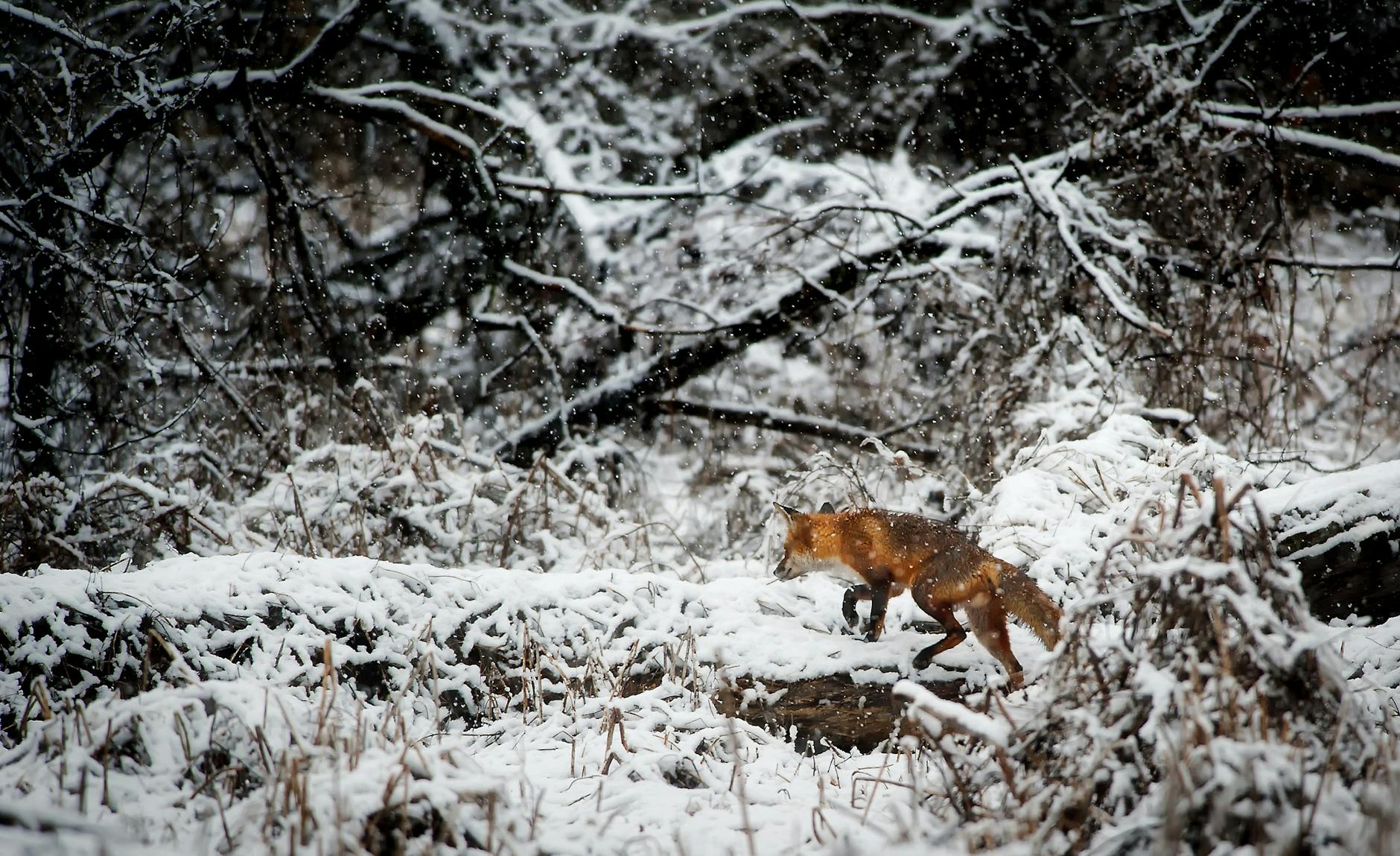
Red foxes Vulpes vulpes begin their breeding season this month. The screams of vixens in oestrus are not unlike the cries of a murder victim. The male foxes too will be barking and yelling to enforce their claim to their territories. They’ll also lay down their musky smell along territorial borders. Throughout the autumn, the males’ testes have been increasing in size, and this month the foxes will reach the peak of their fertility.
The vixen’s period of oestrus is brief, a heat of about three weeks in which she’ll be fertile for from one to six days. Apparently vixens ovulate spontaneously, rather than in response to copulation. All of this makes it imperative for the male to find the vixen and stick with her until she’s receptive. He does this by following her, sleeping close to her and testing her mood by trying to mount.
A successful mating produces a ‘tie’, seen in other canids, where the end of the dog’s baculum swells so as to fix the penis inside the female for up to an hour after ejaculation. While tied, the foxes swivel around so they face both ways, in case of a challenge by other males or by an enemy.
People sometimes find paired foxes stuck together and assume there is something wrong, and try to separate them. This interference can cause serious damage. In an hour or less, the swelling will subside and the pair will come apart naturally. Dog foxes have been seen to curl up and sleep beside the vixen after mating, apparently guarding her for at least a while.
Until fairly recently, red foxes were considered monogamous. A pair of foxes share a den and raise their cubs together, and the den usually passes from parents to offspring. It seems a picture of stable family life. But with close observation of foxes, and especially with scrutiny of the cubs’ DNA, the picture of fox monogamy has expanded.
If truly monogamous, one would think, the vixen wouldn’t need to scream to announce the onset of heat. Her mate would know her condition from her frequent scent-marking at this time. But he may not be nearby, as the pair have probably separated after the cubs were grown; the vixen’s screaming and scent-marking will alert him, or if not that particular male, some other fox. In fact, molecular studies have shown that a litter of fox cubs is likely to have two or more fathers. The dog fox, too, moves on after mating to seek other vixens in heat.
This rather human state of affairs is complicated by the sharing of territory. Foxes, while territorial as individuals, live in groups, in which some animals are dominant over others. Presumably the vocalisations of the breeding season are aimed at these neighbours. If a fox hears another fox call, he or she is almost sure to know whose voice it is; this tells the listening fox the shouter’s status, relative to its own.
Within a group, the dominant male and female may be the only pair who breed. Subordinate members may then help care for the cubs of that year. In carnivores, sociality like this arises when food comes in small, rich, easily taken packets (for example, badgers live socially when their chief resource is earthworms). Foxes too are more sociable the more plentiful and reliable their food is. They are also more promiscuous in conditions of plenty. When prey becomes scarce—a test of the dog fox’s hunting skill—they tend to be more faithful, according to molecular evidence.
Pine Martens
One morning this month, stepping out in the dark to retrieve the camera that watches NJ517470 at night, I saw an orange animal curled up in the light from a window. What could that be, besides a fox or a ginger cat? It ran away without resembling either one. Surely, though, the camera would have taken its picture. But it had only snapped the pine martens, who have been quite active this month so far.
The pine martens have their winter coats, with thick bushy tails. As well as being much thicker than the summer coat, the winter fur is a lighter shade of brown. Presumably this was a pine marten I saw as orange in the half-light.
Both badgers and martens are said to be rather inactive in deep winter. But in past winters, the camera has always recorded both species, usually with a bias towards badgers. This month, however, badgers haven’t appeared every night, whereas pine martens almost always have, often in twos and threes. Two badgers will sometimes show up. But they seem to have looked up the facts on themselves, and decided to have more nights in.

This winter, woodmice Apodemus sylvaticus and bank voles Myodes glareolus have been numerous here. The mice have long since learned to climb to the pine martens’ feeding platform. But also the two species come indoors from September onwards and this year I began live-trapping them. The early months produced greyish juvenile mice and small, immature voles. Now the mice have a more mature pelage, with the dark dorsal stripe over chestnut fur; the voles seem a little bigger. Voles are said to carry on breeding longer in autumn than mice do.
Experienced mammalogists presumably know (I did not) that a Longworth trap can catch two mice at a time. Or you may get a mouse and a vole together. Perhaps it’s a sign that the trap isn’t working as it should.
Annie Lamb
Annie is a zoologist and wildlife recorder. She has run a camera trap in the region for the past ten year.
 North East Scotland Mammal Network