
There’s a tradition that winter begins at the solstice, confusingly often called ‘midwinter’. But whenever we think winter begins, January is usually when the snow comes. It’s also the time when certain mammals start to prepare for spring.
Roe Deer
Male roe deer Capreolus capreolus have now shed their antlers, usually by the end of November. By early January the new ones are already showing. A trail camera set up in Strath Isla took pictures of a buck, on 2 January 2017, with stubby velvet-covered antlers about as long as his ears. A month later a buck appears on camera with well-developed branching antlers still in velvet. It may or may not be the same animal, but the growth of deer’s antlers is famous for its speed. When you see a roebuck at almost any other time, his antlers are clean and bony.
Red Squirrels
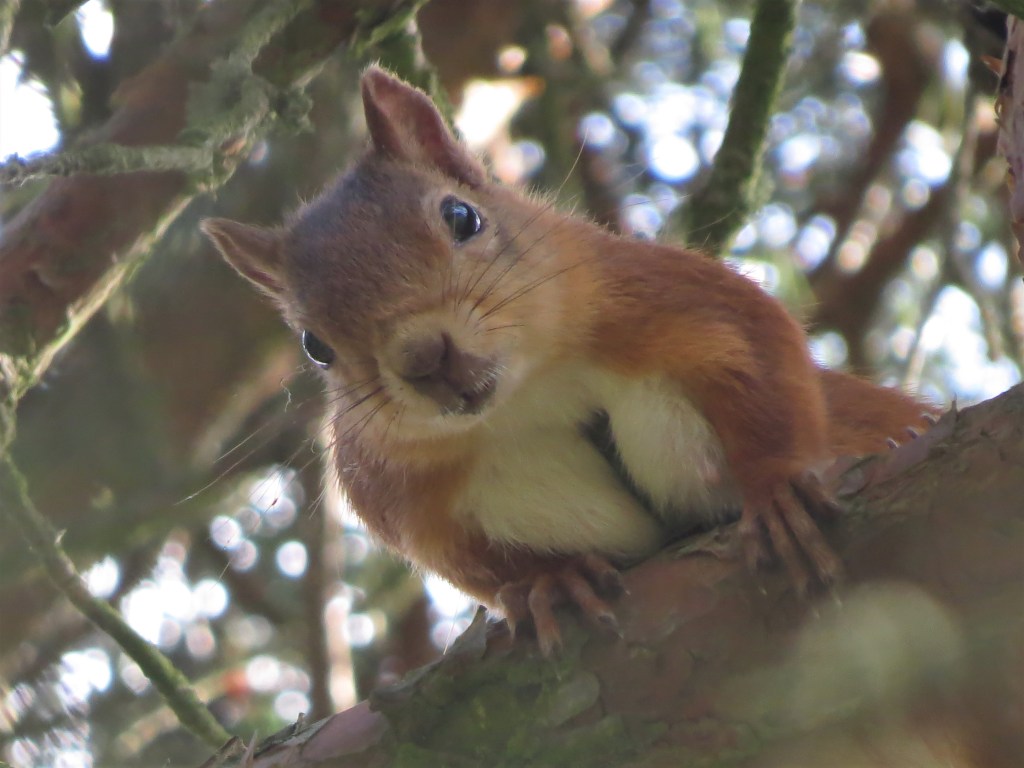
Red squirrels Sciurus vulgaris have adopted their winter activity pattern, with its one peak in a day that ends shortly after lunch. While they are active, they must find food, but also they indulge in wild arboreal mating chases. You might see and hear this going on in any month from December to May, or later, but it’s said to be most intense in January and February. In deciduous woods it’s also easier to see it in winter.
The mating chase is noisy, with male and female chirring and calling. The male, on a branch or tree trunk, loudly slaps the flats of his forepaws on the bark, and approaches the female, who races up the tree and around the trunk (described by J. Holm in Squirrels: Whittet Books, 1987). From there she can leap among the branches, and to other trees, while the male follows, joined by other males attracted by the racket and also no doubt by scent. The female’s call is said to be a chatter followed by an eerie moan, which may serve to bring the males running, although, according to Holm, they don’t all chase after her. Instead they watch the goings-on, then one or two may set off in pursuit along with the individual who set things in motion. Eventually the female will settle for one of the chasing males; we don’t know if this would be the swiftest, or even, given she’ll mate more than once during a chase, whether it is always the same male.
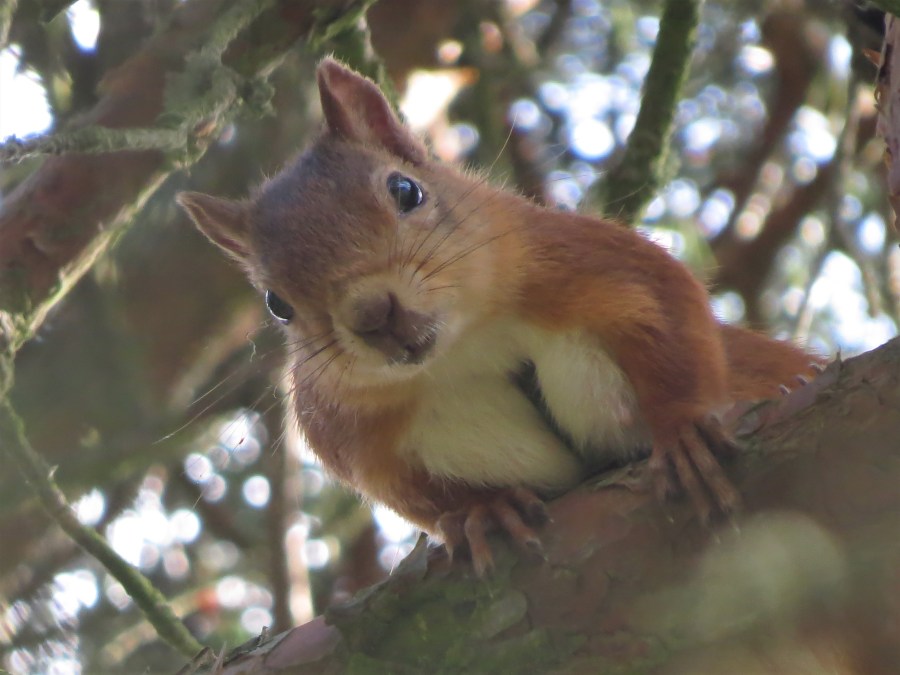
In looking for food, in coniferous woods, the squirrels spend much of their time in the canopy. Next month there won’t be so many cones, so more time will be spent on the ground, where there are caches of food that the animals buried during the autumn. They sniff for these, muzzle to the ground, or to the snow cover, through which the scent of food penetrates. Those caches that a squirrel finds may be its own, but they are just as likely to have been buried by another squirrel.
Rabbit
Rabbits Oryctolagus cuniculus begin to mate in January, the start of a breeding season that extends through to August. Male fertility, judged by testicular weight, rises to a peak in April. Gestation lasts around 31 days, so, although the earliest young will be born in February, most litters will arrive in May.
The female ovulates in response to mating. She may mate again as soon as she’s had her litter, so, theoretically, she could bear young every month from February through September. But in practice it seems she doesn’t.
In some circumstances pre-natal mortality of rabbits is remarkably high. One study found that 60% of litters conceived had failed to be born. They had died as embryos and were re-absorbed. This study was carried out in the 1940s, before rabbit populations crashed due to myxomatosis; studies in the 1950s, looking at smaller populations, found no such losses.
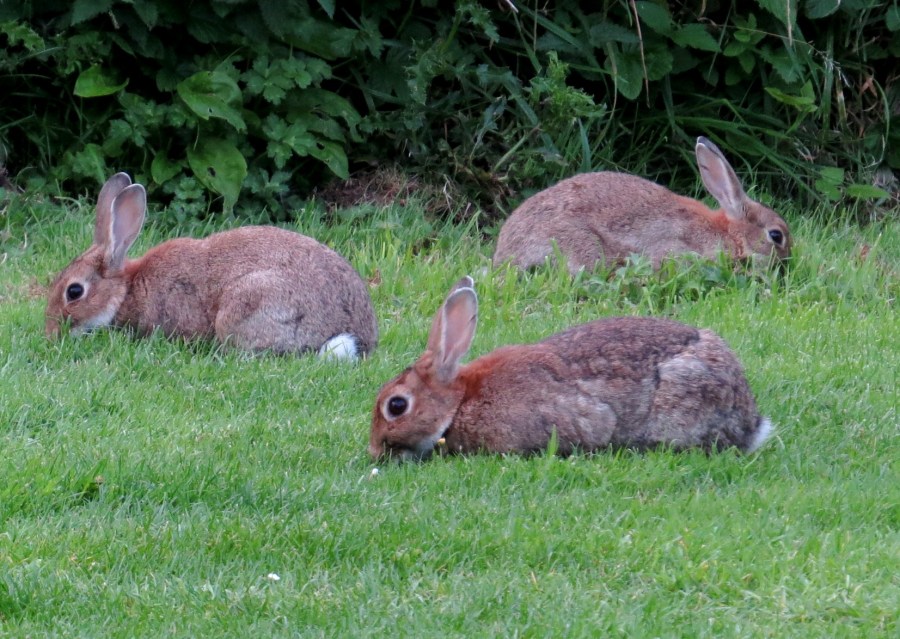
The difference was explained by social pressures and to some extent by body condition. Pregnant female mammals in poor body condition may re-absorb their embryos, as keepers of sheep will know. But also high population density reduces the food supply, and aside from that, it imposes stress on animals that live socially. Most rabbits live in groups, with a dominance hierarchy which determines how comfortably a female can live and rear her young. The rabbits occupy a warren, or system of burrows, within which are one or more brood chambers. The best chambers are claimed by the dominant females. Pregnant sub-dominants must dig something for themselves.
According to Wildlife Online, mother rabbits give their babies only perfunctory care. Their young are born blind, hairless and very small, but even while they’re in this helpless state, their mother only drops in once or twice a day to suckle them, and leaves again at once. On the other hand (from the same source) she has prepared her birth chamber by making a nest which she lines with her own belly fur.
Other writers depict the mother rabbit as a ferocious defender of her young. Rabbits fight with their sharply clawed hind feet, delivering painful kicks. Ernest Thompson Seton (or Seton-Thompson) wrote a fictionalised account of a mother rabbit (a cottontail, very like the European rabbit) fighting off a snake that threatens her brood. He illustrates the battle with a compelling and lifelike painting. During the early twentieth century, when young people read these stories, budding naturalists are known to have been influenced by Seton; it’s hard not to wonder, when online sources mention the mother rabbit’s courage, whether the authors have simply followed the lead of earlier writers. But Seton worked from nature.
Beavers
Beavers Castor fiber mate in January and February, and in mild Decembers, too. There are some videos on YouTube of beavers mating in water, although they may mate out of sight in their lodge. The Cairngorms beavers bred successfully last season (Cairngorms National Park web site: monthly beaver update for 2025). The first sightings of the youngsters were in early June.
Baby beavers are fairly precocial but they don’t come out to forage until two weeks old (says Andrew Kitchener, in Beavers: Whittet Books, 2001), and they will only do so at that young age if the adults for some reason can’t provision them. Ordinarily, they would stay within the lodge for much longer, feeding on leafy branches brought in by older colony members.
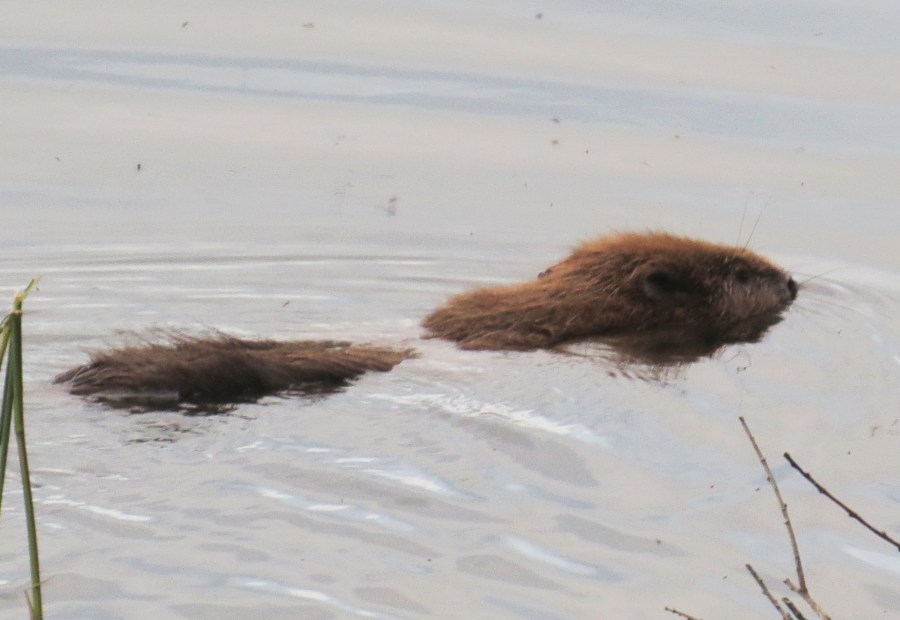
Observers of the Cairngorms beavers inferred the presence of kits in May, 2025, when adults were spotted bringing leafy branches to a lodge and a burrow. The young beavers would be able to eat such food at a week old. So, if their parents had mated in the middle of January, with gestation lasting 105 days, they would be born at the start of May and want solid food by the 8th. And in fact 8 May is the date given for one of the observations.
But the kits seen in June were at different sites, and may have been born earlier. Emergence is related to weaning, which is gradual: a month after birth, the milk supply starts to drop. But the kits won’t be fully weaned for at least another month and possibly another two. On the other hand, important teeth are present at one month old. If for some reason they’re not being fed, the youngsters can leave their shelter to seek food.
Since so many aspects of the beavers’ life take place where they can’t be seen, it’s fortunate that the Cairngorms population is closely watched and a record kept.
Scottish Wildcats
Scottish wildcats Felis silvestris grampia look fabulous in snow. Beautiful photographs have been taken of the cat against a snowy background. With its deep winter coat, the animal appears bulky and even rather short in the leg, but this is mostly an impression due to the thickness of fur. Under the thick coat, the legs are actually rather long in proportion to the body compared with the legs of domestic cats, so it’s said.
But according to the biological species concept, the two cats belong to a single species: they interbreed and produce completely viable offspring. Many of us in the northeast have met a so-called hybrid wildcat, since they’re not uncommon among farm or household cats. In fact the wildcat’s greatest danger of extinction seems to be its eventual replacement by its cross-bred descendants.
In spite of iconic photos, wildcats don’t thrive in places where long-lying, deep snow is the rule. Luckily for us and them, we don’t usually see that much snow for that long (20cm lying for a hundred days, according to Animal Diversity Web). But we see plenty of good wildcat habitat, with open ground for hunting, and snug refuges under the fringes of woods. The cats will take rodents, rabbits where they can get them, weasels, insectivores, various herpetofauna, and birds, which are said to be a less favoured prey.
Wildcats start to breed in January and the season lasts into March. Mean gestation is 65 days (some authorities give more, and some give less), so there will be a chance of kittens as early as the third week of March. There’s nothing to distinguish the development of wildcat kittens from what we’re familiar with from our own cats, except that kittens in human households are generally weaned younger. Wildcat kittens are weaned at three months or more; the female is able to produce a second litter, but unless she loses the first one, she won’t have more than a litter a year.
Feral domestic mother cats take the trouble to bring active prey to quite young kittens, who then have a chance to learn some skills before leaving their natal refuge. Presumably, wildcats also give their kittens living prey. As they grow, the youngsters will start to go out to hunt and explore, until, at around five months old, they become independent of their mother.
Since domestic cats come into heat in response to increasing daylength, we would expect female wildcats to do this too. According to the Mammal Society’s account, females are sexually mature at a year old; other sources give a younger age, from six to eleven months. Most kittens are born in April and May, we’re told. If this is to agree with the other statements, if mature at one year the cat must breed late; if mature at six months she’ll wait a few weeks, and take her cue from the lengthening days of the new year.
Annie Lamb
Annie is a zoologist and wildlife recorder. She has run a camera trap in the region for the past ten year.
 North East Scotland Mammal Network