
Late winter is often a time for snow, which means that snow is a sign of spring. It refills rivers and inspires a range of sports. But now, as food grows scarcer, many mammals are facing harsh and risky conditions. For some, though, February is a month of opportunity.
Pine Marten
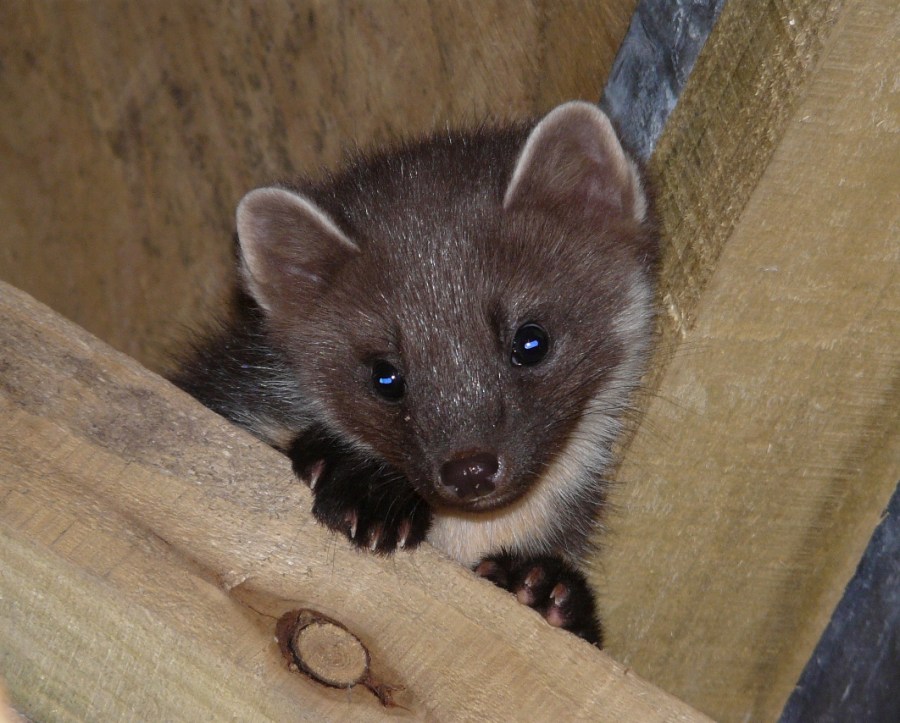
A pine marten Martes martes has been slipping in and out of the old stone workshop here at Ruthven. For the past few years, it’s been routine for the mother marten to move her young into the roof of the building sometime in May. They stay for some weeks and emerge on summer evenings, setting out in line along the ridge flashing. They haven’t been noticed indoors in the winter before. But one of them has been leaving its muddy footprints on things, although it’s probably more interested in a cosy spot under the roof.
This could be a last summer’s youngster; in February, young pine martens start to disperse. Lately the trail camera has been catching two martens with slightly differing lengths of tail—probably they only look different on account of the way their winter coats have grown. But one could be a juvenile who has stayed with its mother and is now exploring the neighbourhood’s possibilities.
Some online sources state that pine martens’ breeding is not well understood. But it shouldn’t be a mystery, really. People have bred them, producing, in one case, the most unstoppably active pet in the history of pet animals. Such breeding can only be done under license, and a pine marten can’t legally be kept unless bred in captivity, so, presumably, instances will be rare.
Pine martens mate in summer, but the embryos are not implanted until late in winter—around February time—and since gestation lasts ‘about thirty days’ the young tend to be born in March or April. So if the animal in the roof is a mother marten rather than a young one (who won’t be expected to breed until the age of two) there should be evidence of it in a few weeks’ time.
Otter
Otters Lutra lutra have no definite breeding season. But February is their principal time for mating. Females come into oestrus cyclically and are in heat for two weeks, and will give birth after 60 days or a little more (like cats).
In the winter, with snow and ice, the otters make themselves slides. They do this at any season with mud, but wintry conditions are best. Not only do they slide down slopes into water, but when hurrying along on the level they use ‘a combination of running and sliding’ (says Global Biodiversity Information Foundation) when snow or ice permit.
Observers have always said that otters are ‘playing’ when they slide into the water, since there’s no function for whizzing repeatedly down the same slope except for the thrill of speed. Human beings need no other reason for sliding on snow or ice. Humans like company when they play this game, and otters do, as well.
A description of otters enjoying a slide is given by Thompson Seton (1913), who probably watched the North American species (Lontra canadensis). His otters are ‘jovial’; comparing them with other predators, he points out that, as fisher-folk are gentler than hunters, so in the animal world the otter is relatively easy-going. Hence its fondness for sports and companionship. Part of his account is quoted by Jim Crumley in the Scots Magazine (www.scotsmagazine.com/articles/stories-snow-otters). Crumley knew that his Scottish otters went sliding at night on the slope above a local pond. He never could catch them at it, however, instead deducing their actions from the marks left in the snow.
In our area, we might see otters or otter sign wherever there’s running water. Their spraints and tracks often used to appear alongside a ditch here, especially in spring when there were frogs about. In the past few years, they’ve been missed (and frog numbers are way down). But the tidal reaches of the Findhorn or the Ythan might be good places to look for sign, or to sit quietly very early in the morning for a sighting.
Badger
In contrast to pine martens, a lot is known about breeding in badgers Meles meles. According to Tim Roper, however (New Naturalist Badger, 2010), we need to be careful interpreting the many studies, because most were done on only a few populations. A published assertion may well apply to Oxfordshire badgers or Dorset ones, but might not be true for badgers farther north, because, evidently, latitude and climate affect the timings of badger births. The harsher the conditions, the later the babies.
February appears to be the most likely birth month for English badgers. The mean date might or might not be later in north-east Scotland. To work out a rough date of birth for a cub, we could extrapolate back to it, if the date of emergence from the sett is known. When the cub is first seen out with its elders, it’s probably twelve weeks old. For cubs born in February, this suggests that you’ll see them first in May.
Badgers are an extreme example of delayed implantation. Mating goes on throughout the year, but the resulting blastocysts could wait weeks, even months, before implantation. Or those blastocysts could abort, and a fresh mating might provide new ones. But, whenever they were conceived, they’re all implanted at around the same time. From studies in England, this happens late in December; gestation is fifty days, which puts birth mid-February.
But this isn’t true in all cases. Roper (2010) points out that social constraints put pressure on female badgers. Their body condition is sensitive to stress, and this, in turn, influences the timing of implantation. Females with plenty of body fat implant their embryos promptly, while lean females do so later. So the cubs of females in better condition are born around now. They will have ample time to lay down fat before they face their first winter, and are more likely to live through it.
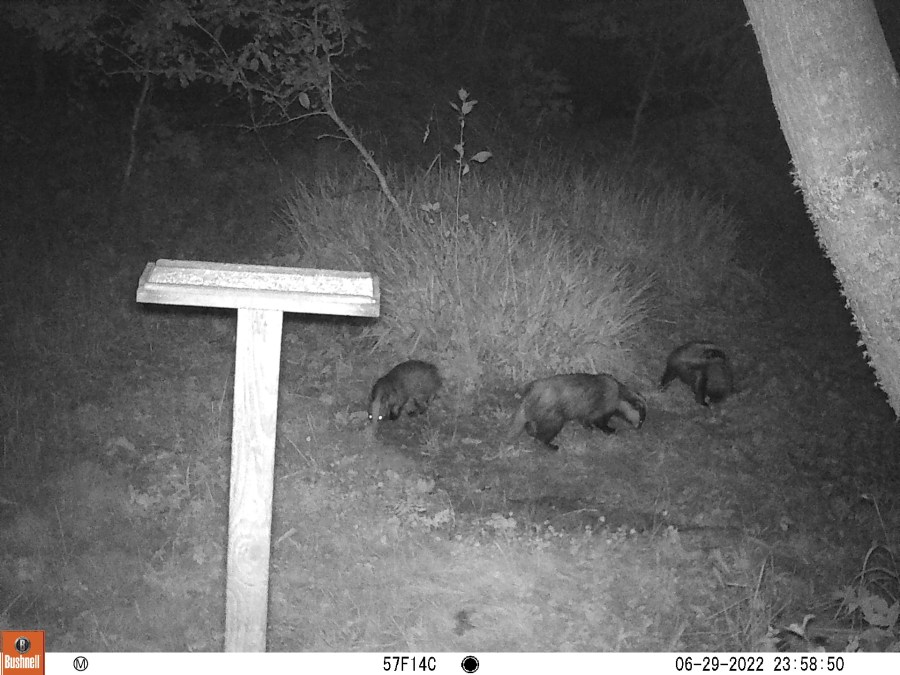
Casual observation isn’t enough to pin down emergence dates for cubs. The camera trap here has operated now for over ten years. However, this long record shows very few apparent cubs. At twelve weeks they should have clear black facial stripes, like adults, while retaining their plushy short body fur. Next to adults, they should look a bit small. Unfortunately, for some reason, it’s hard to gauge relative size in camera trap photos. As for plushy fur, it should be obvious but it’s not. Sometimes, among these records, cubs turn up who have pale facial stripes and thin hair; going by illustrations in Roper (2010) these can be only ten or eleven weeks old. But these photos appear in high summer, so the cubs must have been born in April.
That doesn’t bode well for their chance of living through winter. Still, over time, the local population seems to hold steady. So it’s likely that plenty of cubs survive, having been born early enough—around now, in fact.
Hares
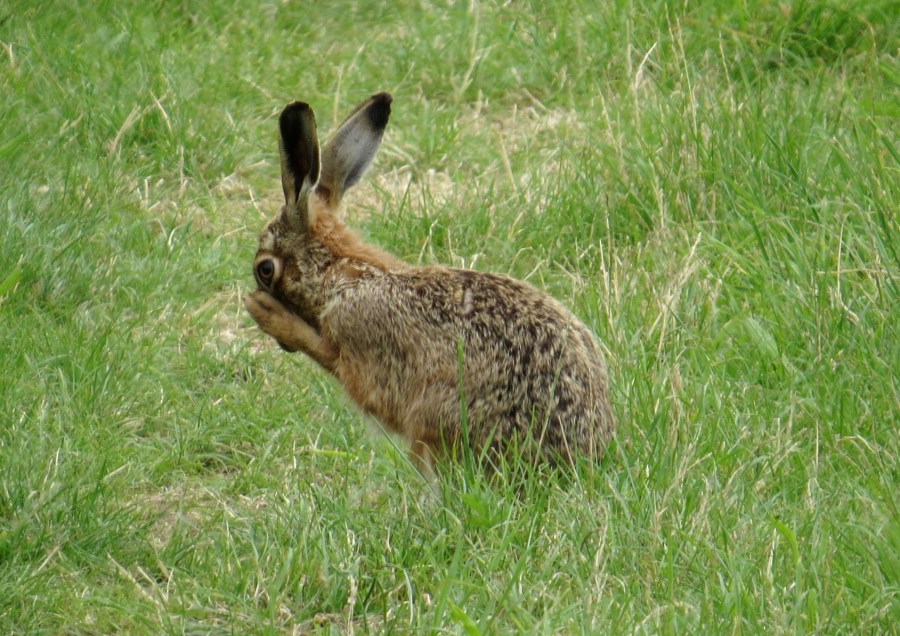
February marks the start of breeding for brown hares Lepus europaeus. It’s now that we see them boxing and chasing each other, the preliminaries to mating. Brown hares seem conspicuous now because we see them in daytime, whereas normally they are active chiefly at night.
The boxing matches of mad March hares are documented on YouTube and elsewhere. The ‘madness’ probably refers to their disregard of danger while focussed on sex, and ‘March’ is accurate too, because they won’t stop acting mad for a while yet.
But it’s well known that ‘boxing matches’ is a misnomer. Matches would be contests, as between rivals. Hare boxing is an encounter between a male and a female. The male is interested in mating. The female, however, when he gets close, rises to her hind legs and hits his nose with her forepaws. He smacks her paws aside, as anyone would, and soon they are boxing away like fury (see, for example, https://www.youtube.com/watch?v=nSLqGVDc1XU), both standing tall, with short breaks for chasing on all fours. One video shows one of the hares landing a flying snap kick on the other’s chin.
Mountain hares Lepus timidus behave in the same way. They are nocturnal but, like the brown hares, they may be seen boxing and chasing in daylight (https://www.youtube.com/watch?v=yzyZMgt2AN0). Their mating season began in January and may well be on-going now.
In the literature, this behaviour—boxing with the male and making him chase her—is sometimes said to be the female’s way of testing his fitness. Or the authors may interpret it all as a signal that she isn’t ready to mate. If this is so, the male is remarkably slow to take it in. But she certainly is testing his fitness, considered as an athlete if not as a sire of young. Hares are induced ovulators; maybe they ovulate in response to a brisk round of sparring, followed by mating, rather than solely to mating (although this addresses only the proximal causes).
February seems a good time to see hares anywhere in arable land, pastureland or on higher ground. Over the last few nights, the camera here has recorded a brown hare, and one was seen by day at close by. But mountain hares are the usual spoilers of fruit trees, not far away near Drumnagorrach.
Red Deer
For red deer Cervus elaphus, the time of highest mortality has begun. The stags exhausted their physical reserves in the rut of October. Since then, as they have sought to recover, available food has diminished steadily and what’s left is increasingly hard to find. Next month the stags begin casting their antlers; before they can put resources into growing new ones, they must survive a long hungry gap in which many of them will die.
The hinds too are facing a hungry spell, especially in-calf hinds who should be eating for two. Also this is a time when many calves from the previous year or two will die. The Red Deer on Rum project’s account emphasises the toll that winter takes on calves. Even mainland herds, with access to woodland or shelter from the topography, experience similar losses of young and elderly animals. The underlying cause is starvation (Putman and Green, British Deer Society: https://bds.org.uk/wp-content/uploads/2021/03/Winter-Deaths-Among-Open-Hill-Populations-of-Red-Deer-in-Scotland.pdf), but its impact is made much greater by wet and cold and wind: the chill factor.
Earlier in winter the deer began to call upon their reserves of stored fat. By February, if conditions are harsh, they can conserve energy by damping down their metabolism, while living on such fat as they have left. When this is used up they can only metabolise muscle. They can’t gain any surplus from food, since now there is nothing around to eat that’s worth eating. Grass and forbs are yet to appear; the bark and buds of woody plants are eaten but have low food value. Now the ever-present parasites increase to potentially lethal levels. Even when spring comes, or when someone carries food to the herd, many animals are sinking past recovery.
The survival of deer over winter, then, depends on their feeding beforehand. (The BDS authors argue that supplementary feeding can be really counter-productive.) Ideally the deer eat well in summer, and go into the rut in good condition; after the rut they should have time to recover their strength before winter begins. Those who don’t manage to do this are at risk of dying.
Beavers
Cairngorms National Park Authority report each month on the Park’s beavers Castor fiber (https://cairngorms.co.uk/document-collection/monthly-beaver-updates). Last February, they noted that water levels were high. This year, after the thaw of long-lying snow followed by weeks of rain, once again there should be plenty of water. Beavers make use of water for transport of food and building materials; they travel by water, it protects them, and often they mate in water. Their mating season started last month, but females who failed to conceive will come into oestrus again, and perhaps mate successfully this month. Last year, the Cairngorms observers found that beavers had stripped bark, felled small trees and left other feeding signs at most of the sites monitored. The beavers had also been exploring and had found new places to forage. They had built up one of their lodges to cope with the rising water level. Since it’s the sound of trickling water that stimulates beavers to make repairs, they must be very busy plugging holes just now. But rather than giving them too much to do, the high waters will probably help them by extending their possible range.
Annie Lamb
Annie is a zoologist and wildlife recorder. She has run a camera trap in the region for the past ten year.
 North East Scotland Mammal Network