
March is a challenging month for wildlife. The temperature shoots up, then it plummets, and there may well be snow. But many mammals are being born this month. The literature tells us that this is advantageous, because in springtime, there will be more food. But that depends on what the mammals eat, and on how the changing conditions affect what they feed on—some of them being food for others.
Red Squirrels
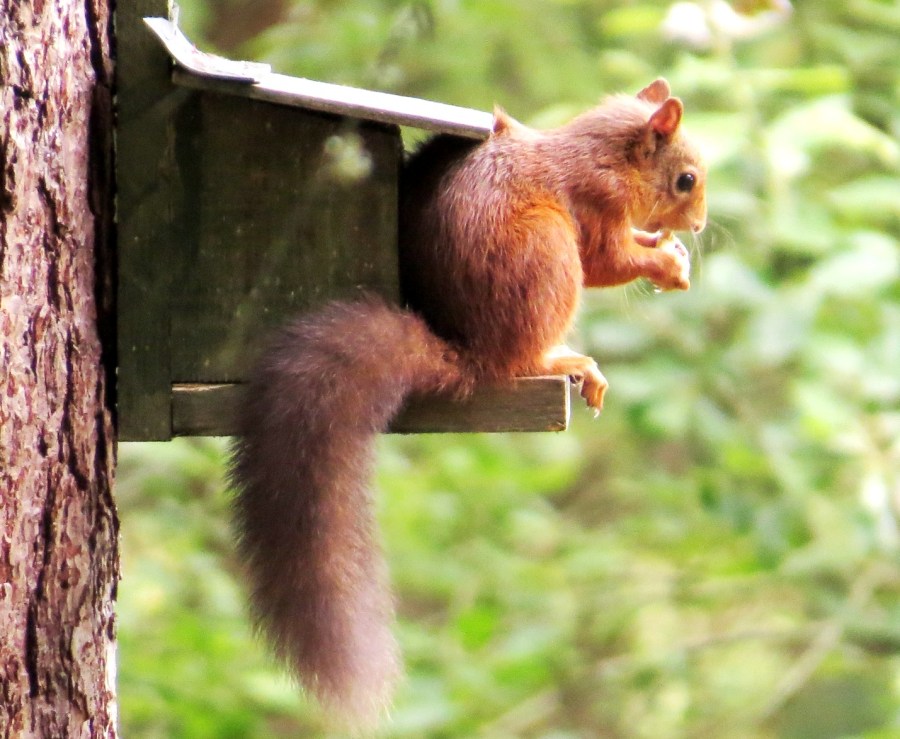
Red squirrels Sciurus vulgaris have a long breeding season, from late winter into high summer, when they may have a second litter. But according to J. Holm (Squirrels: Whittet Books, 1987), most squirrels are born in March. The expectant squirrel either builds a new drey for the birth, or improves an existing one: ideally it should be extra snug, with a thick, soft lining. Here the litter of about three young (ranging from one to six) will be born in quite a helpless state, blind, hairless and deaf. Their mother will stay close by at first, but soon she will forage farther afield as she needs more and more energy for lactation. As time goes by, there’s more she can eat: buds on the trees, catkins and other flowers.
By three weeks old, the young have short fuzzy coats, and their eyes and ears are about to open; their teeth emerge, they begin to gnaw, and their claws and forelegs grow strong enough to hold them on vertical surfaces. With luck, they won’t need to climb anything until they start to go outside at about seven weeks. But they may find themselves outside prematurely. Mother squirrels are sensitive to disturbance and will carry their offspring, one at a time by the scruff, to another nest if any disturbance makes them suspicious of the first one. It’s necessary to maintain more than one nest to have this option. You might happen to see a female shifting her litter between dreys; otherwise most of us never see infant squirrels.
Pine Marten
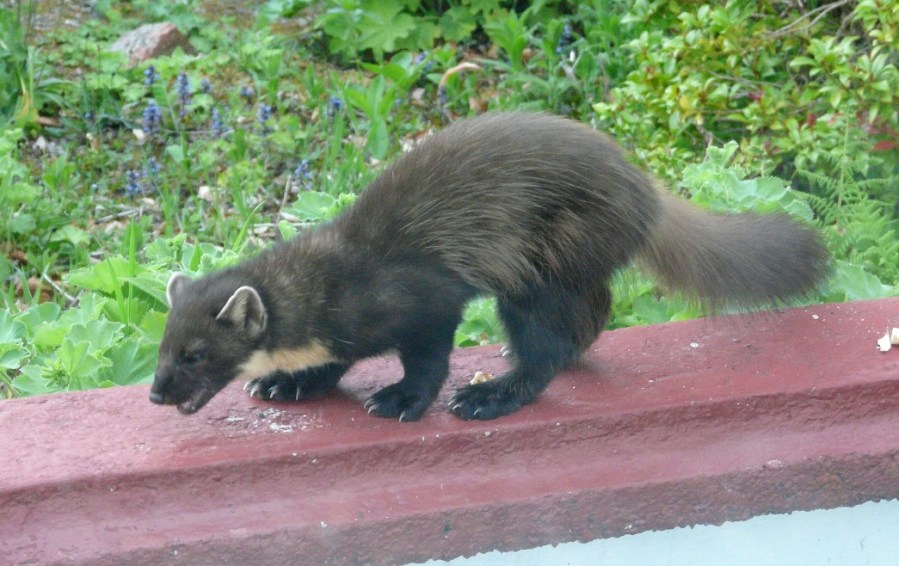
Late this month, or early in April, pine martens Martes martes will give birth to the young conceived last summer. The pine marten kits’ early life is a lot like that of the baby squirrels. They too are born in a tree, or in your roof space—any such hole that’s high up, safe and warm. And like the squirrels, the martens will begin to go out and explore at six or seven weeks old. But unlike the squirrels, though born with their eyes closed, newborn martens have silvery baby fur.
Spring brings abundance of food for pine martens too. For example they prey on wood pigeons, which breed almost anytime but especially in spring. Eggs and nestlings should be plentiful soon, and as they grow, pigeon poults will make a fair-sized meal. The martens might also prey on squirrels. In the trees, red squirrels, being small and light, can escape pine martens by way of the slender tips of the branches. But in the nest, the young squirrels are vulnerable; their main hope is to have the entry hole too small for the much larger marten.
Wildcats
Wildcats Felis silvestris mate mainly in early March. Some of the 19 captive-bred wildcats who were released in the Cairngorms in 2023 are known to have had kittens in the following two summers. At least as far back as 2010, the species was pronounced extinct in the wild, so it’s exciting to think of a new wild population arising. The kittens of 2024 are now old enough to breed, and quite possibly last year’s young will be sexually mature too.
The chief threat to the survival of the Scottish wildcat as a species appears to be introgression between wildcats and F. catus. Pictures of the Cairngorms kittens (arbtech.co.uk/scottish-wildcats-breed-in-cairngorms has a comprehensive summary and photos) show them to have the wildcat phenotype, at least. Someone is sure to collect evidence to assess their actual parentage, so, eventually, we will know whether this is a new beginning for wildcats in Scotland or whether things are going the same way as before. It is hard to imagine a world where cats don’t mate promiscuously.
Roger Tabor (The Wild Life of the Domestic Cat: Cornerstone, 1983) describes the way free-roaming tom cats and females use their home ranges to find mates. As with many mammals, the tom’s range is larger than the female’s and overlaps with more than one. The individual cats time-share their space, as well, so there ought to be plenty of opportunities for matings to occur. Wildcats may show similar behaviour, but being unsupported by human beings, they have a far smaller population; they will be more sparsely distributed, and won’t bump into one another as frequently. We have to hope that the new wildcats succeed in meeting up.
Roe Deer
At Ruthven, early this month, a roebuck Capreolus capreolus appeared on camera wearing his new velvet antlers. At that time they looked almost full-size. Recently (20-22 March) a buck, possibly the same one, has been noticed in daylight and at dusk, turning up in all kinds of places. His antlers look fully developed and bony, although, as he runs off so smartly, it hasn’t been possible to be sure he is out of velvet. He is in great condition, seemingly.
Red Fox
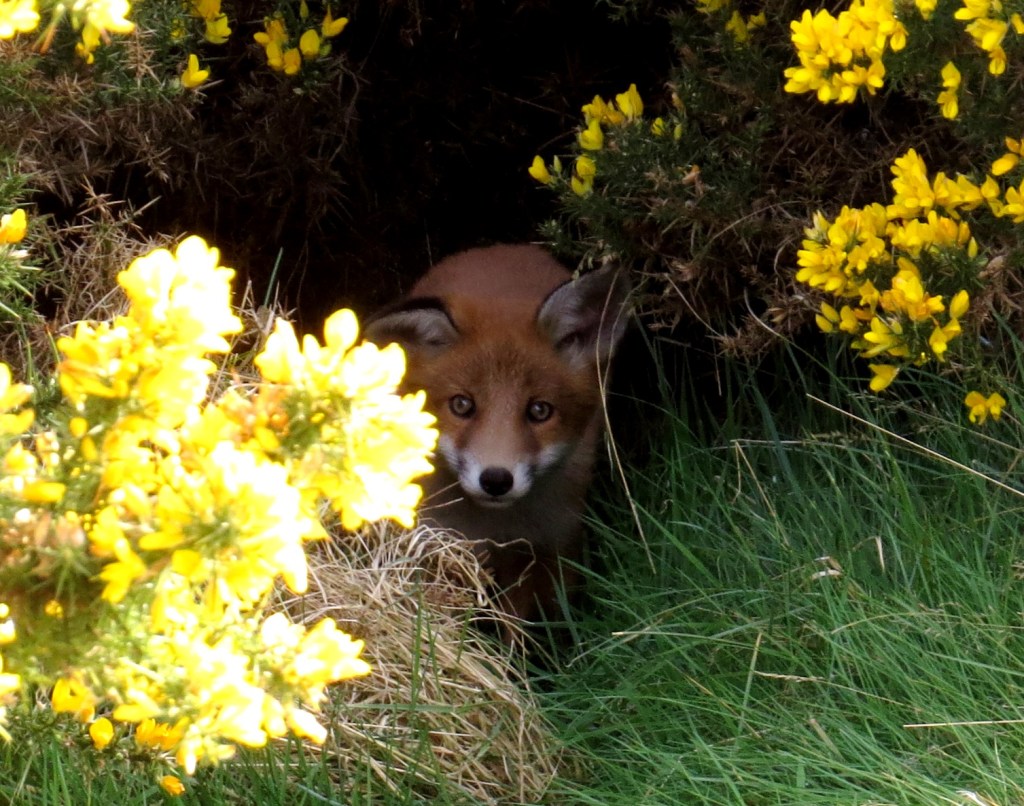
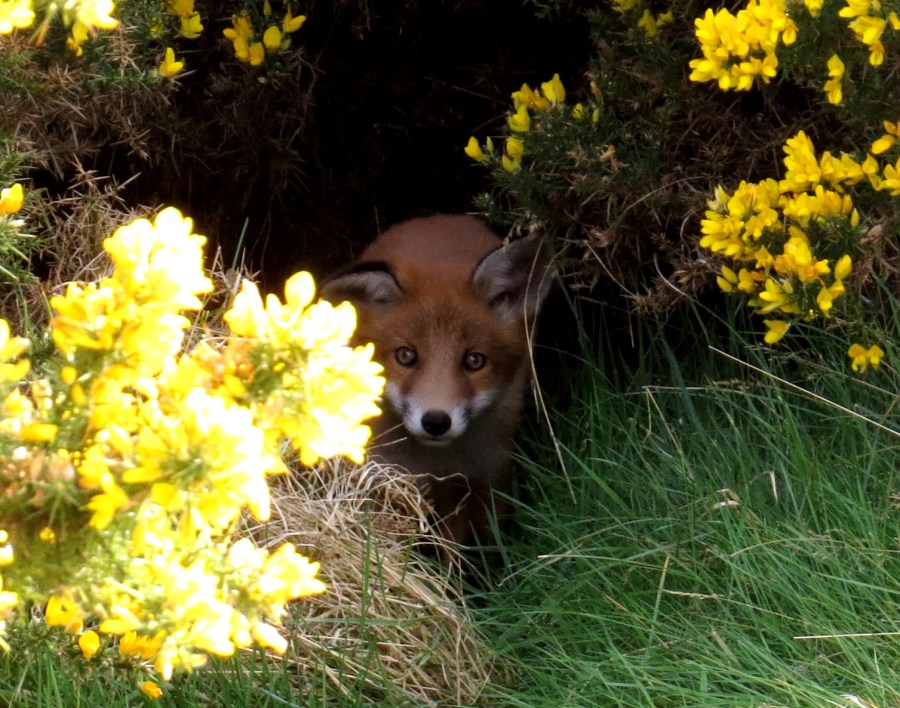
Foxes Vulpes vulpes give birth between January and late April, mostly, with a peak in March. According to the literature (for example national-fox-welfare.com and wildlifeonline.me.uk), their gestation is only 52 days—short compared with the cat’s (about 63 days). Mother foxes dig out and furnish an earth well before the cubs are born, and they will stay in there with their litter for about the first twelve days. The newborn cubs must be kept warm, and suckled, during this blind-deaf-and-fuzzy stage; the male brings food for the vixen, and there may be some non-breeding female helpers too. At three weeks, the cubs are ready to emerge and play-fight near the entrance to the earth. This is when you may hear them and watch their play. Apparently it’s also the first time their father sees them.
Foxes respond to the abundance of prey, at individual and population level (says wildlife-online). More cubs are born when rabbits are abundant; voles are important too. Both these prey species have population cycles so this affects fox numbers. Larger litters are born, not only at times when food is plentiful, but also in rich habitats that support more small mammals. The cubs usually number between four and six, although larger litters are reported—possibly because of cross-fostering, since foxes are quite sociable.
But prey abundance also influences the sex ratio of the cubs, even affecting the survival of embryos. Males seem to be favoured by their mothers in terms of greater investment. They are born heavier than female cubs and it’s mostly female embryos that die in utero. Moreover, where there is plenty of food, more male cubs are born. So the foxes’ demographics are shaped, in some ways, by rabbits and voles.
Voles
Bank voles Myodes glareolus begin to breed in March. A female vole could produce, as an estimate, 36 offspring in a year, with a possible nine litters of four young at a time. In fact, wildlife-online suggests that she may have up to nine in a litter. But a year would be a long life for a vole, since everyone wants to eat her. MammalWeb lists ‘stoats, weasels, kestrels and owls’ as predators of bank voles, but foxes are major consumers too, especially when they are cubs and learning to hunt.
Once the voles have begun to be born their numbers may increase swiftly. After giving birth, the female is receptive to a fresh mating. Her offspring may breed when they’re eight weeks old. Then, gestation lasts from 16 to 20 days. A vole conceived during March may be born early in April, and at some point in June she herself may be ready to mate. The breeding season carries on into October; it seems to be governed by the temperature and available food, rather than by daylength. Voles are induced ovulators and so not tied to an oestrous cycle.
Wood Mice
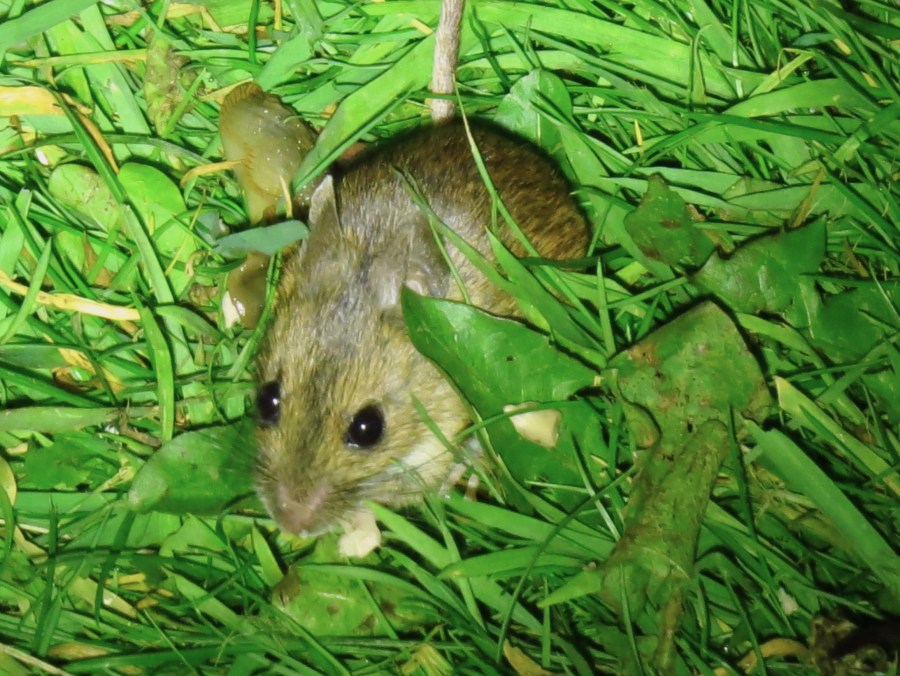
Similarly, wood mice Apodemus sylvaticus start to breed this month, although they may have an ‘out of season’ oestrus if conditions permit. Wildlife-online gives very detailed accounts of animals and among other things explains what the name Apodemus sylvaticus means: the wild mouse that does not live in houses. In our area it’s the one that does. In contrast, house mice Mus musculus are now quite rare indoors (unless pets).
Wood mice have a three-week gestation: ‘first pregnancies evident by April’, says wildlife-online. That is, pregnancies are evident to folk doing capture-mark-recapture studies. Towards the third week of April, in such a study, one might be trapping lactating wood mice. Their litters are likely to starve meantime. So, at Ruthven, where live-trapping has been ongoing over winter (not marking, but almost certainly recapture), it will have to stop soon. In any case it’s rare to have Apodemus indoors here after the weather turns warm, when outdoors is hopping with helpless invertebrate prey.
In general, numbers of mice and voles should swell during spring and early summer. Their predators can look forward to a time of plenty. But it probably won’t feel like a time of plenty to lactating predatory mammals. Rearing young is a constant round of hunt, catch, carry, suckle (or throw up) and hunt again, with little left over for a mother to maintain herself.
Annie Lamb
Annie is a zoologist and wildlife recorder. She has run a camera trap in the region for the past ten year.
 North East Scotland Mammal Network