
One of the wonders of our part of the world is the speed of the change in daylength. In April, as darkness falls later each night, the change accelerates. Many nocturnal mammals emerge before it’s completely dark.
For bat watchers, this can mean increasingly late bedtimes. At our latitude, darkness falls very slowly; because we can see for so long after sunset, the twilight invites us outdoors. In the early evening the bats we’re hearing on the bat detector can be seen against the sky, especially when flying among bare branches. After the leaves come out, the shelter of broadleaved trees will form patches where insects gather, but the bats hunting them will be harder to see.
Common pipistrelles Pipistrellus pipistrellus and soprano pipistrelles P. pygmaeus, emerging 20 to 30 minutes after sunset, are almost certainly present here at NJ516470. The frequencies captured by Elekon Batscanner are clustered around two values: 44 kHz, and 55 to 60 kHz. The few intermediate readings are usually around 48 kHz, suggesting Daubenton’s bat Myotis daubentonii—unlikely, with no water nearby—or Natterer’s bat M. nattereri, which the Mammal Atlas suspects is under-recorded in Northeast Scotland. Meanwhile our two pipistrelles are seemingly flying together, in the lee of cypresses and the more distant spruce forest.
The distinction between these two pipistrelles may seem to be long established. But many of us remember the breaking of news that P. pygmaeus was a separate species. The story of the discovery, with details of individual researchers, is given in Henry Schofield’s 2002 paper, ‘A Guide to the Identification of Pipistrelle Bats’, which is available on line.
The suspicion that P. pipistrellus was two species was first aroused at Bristol University, where investigations began in or around 1992; finally, in 1999, P. pygmaeus was given the taxonomic status of species. There are several differences between the pipistrelles in behaviour and morphology. So with hindsight, we might wonder why the distinction wasn’t obvious in the first place. But not much can be obvious with bats, without a concerted effort from several disciplines.
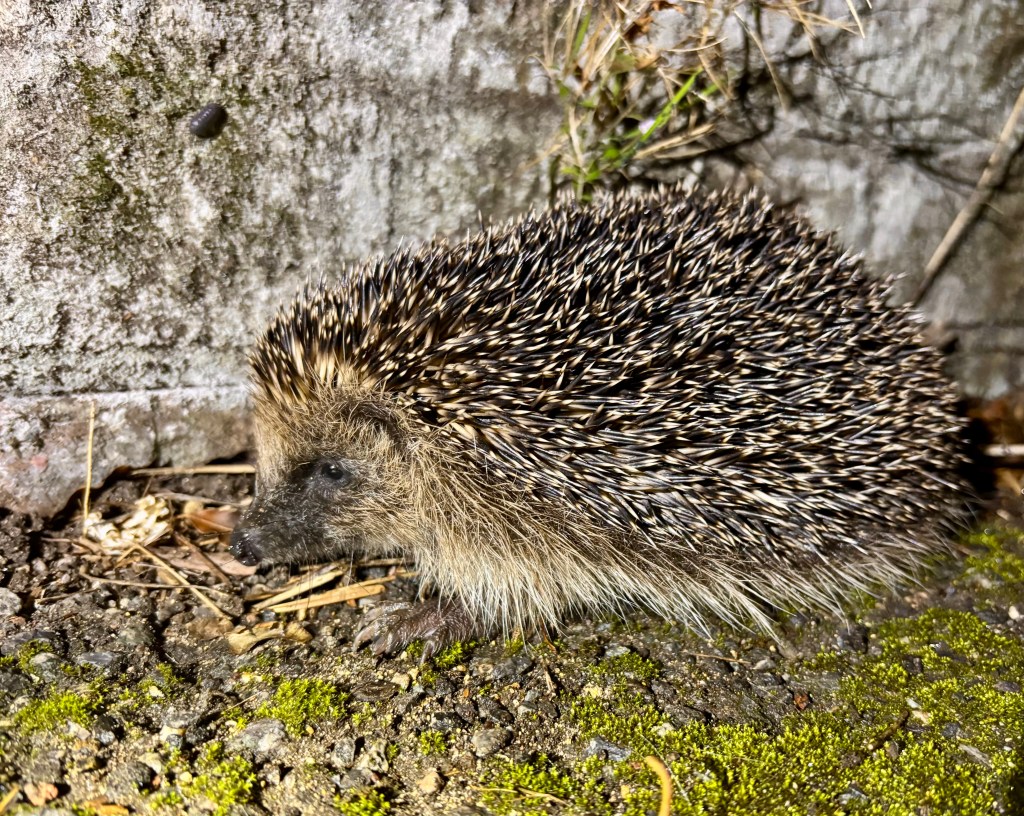
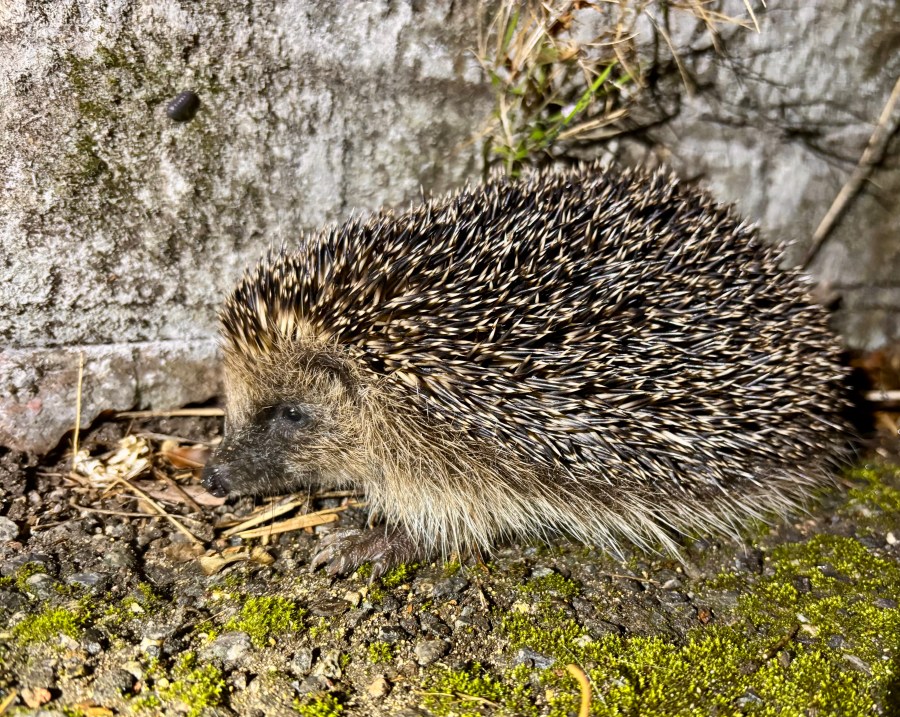
Hedgehogs Erinaceus europaeus are now finished with their hibernation. Males will have been out since March, as they emerge a bit early compared with females. Their mating season gets started in April; in May, it will intensify to the point where it’s known as a ‘rut’.
This month, a hedgehog has twice been snapped by the trail camera at NJ517470. We hope it won’t be snapped, literally, by the resident badgers, who were on the spot each time both before and after the hedgehog was there. It’s not clear what brings it into the open when there is so much cover available. It trundles through, not especially quickly, exposed to its worst predator and to a frequent fox as well.
In April, many weasels Mustela nivalis are born. Their breeding season began last month when the males’ testes grew large and heavy; if the males live through summer, their testes will regress. Ovulation in weasels is thought to be induced by a long copulation. The literature emphasises the furious mating behaviour of weasels, in which the significantly larger male comes across as very aggressive.
In contrast, the artist Robert E. Fuller, who observes mustelids closely, has described an affectionate relationship between a male and female weasel he followed (www.robertefuller.com). The pair copulated rather tenderly but never had offspring. Then the male developed large testes, completely changed his attitude towards the female and drove her away. Later she mated with a different male, with typical weasel violence, and became pregnant.
Weasels are among the small predators exhibiting Dehnel’s phenomenon, the ability to shrink and then re-grow the brain. Their brain volumes diminish with the approach of winter, but increase again in spring, starting about now. Male and female weasels differ slightly in their response to spring: the male’s brain volume, standardised as the ratio between braincase height and condylobasal length, hits its mean low point in March and increases to a new high point in August. It doesn’t grow back to its original value but at least it grows; for the female, it scarcely does so. The reason why this doesn’t mean that her intellect is impaired may be partly explained by studies of the brains of common shrews Sorex araneus.
In October 2025, Baldoni et al. published in Current Biology their findings concerning Dehnel’s phenomenon in S. araneus. Their work to that point had focussed on the shrinking of brain size; they continue to investigate how the brain then re-grows. There are implications in this for the treatment of human neurodegenerative diseases, in which brain shrinkage also occurs, but without subsequent recovery. In the shrews’ brain the shrinkage is accomplished by changes in the water balance within and outside of brain cells. The number of cells doesn’t decrease; there is even an increase in cell number associated with the change, with the neocortex (the site of memory) and the cerebellum (co-ordinating movement) becoming more densely populated with neurons. Neurogenesis is very unusual in the adult brain, these authors point out. The adaptations they found appear to maintain the brain’s connectivity and thus its vital functions during the winter.
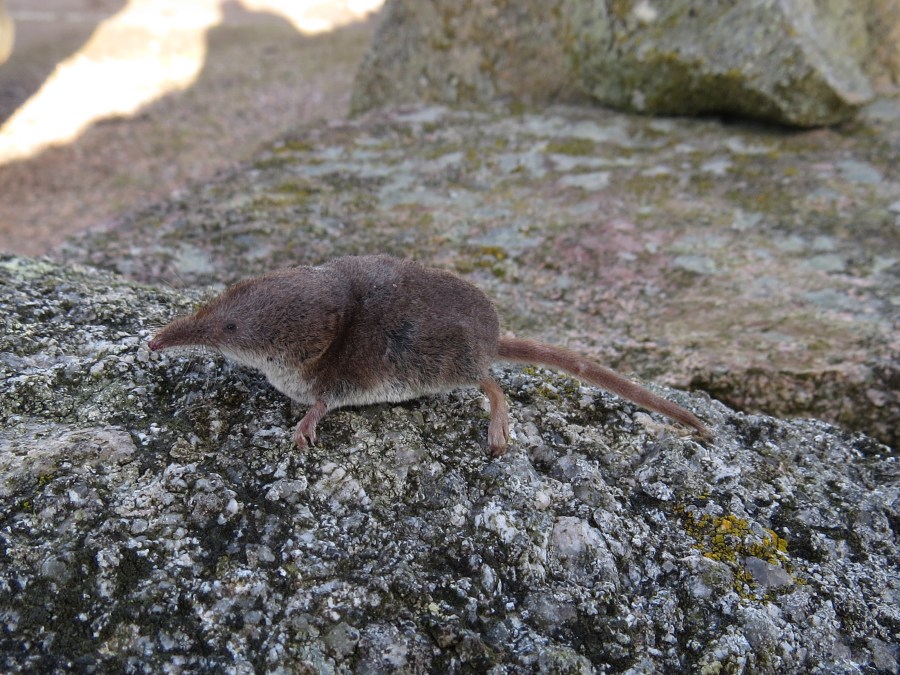
Now that it’s April, the shrews can put all that behind them. Their brain volume has been on the rise since February and is halfway to its new peak. In a few weeks they will be breeding, and at summer’s end they’ll die of old age. Like the weasels, they will not re-grow their brains to their former maximum size; the final mean volume is slightly smaller than the original one.
According to references cited by Baldoni et al., seasonal brain shrinkage is known in weasels, stoats Mustela erminea, moles Talpa europaea, and the red-toothed shrews (Soricinae). Water shrews Neomys fodiens belong to this group. They are our largest shrews, up to 96mm in total length (says Guide to the Mammals of Britain & Europe: Elsevier, 1976) compared with a common shrew’s length of 85mm. Water shrews are also noted for their poisonous bite and for their adaptations to foraging in water. When diving, the shrew appears covered in silver, because its outer coat traps a layer of air. But it is actually black (or very dark) and white: the coat has a sharp delineation between the upper part and the white underside. The shrew’s body is plump and streamlined, like a penguin’s. Its tail carries a vertical fringe of stiff hairs, acting as a rudder, and more bristles grow on the feet, making them efficient paddles.
In spite of foraging underwater for small fish and invertebrates, and usually having a home range along a waterside, water shrews may take a good deal of terrestrial prey. A study of their habitat preferences by van der Putten et al. (Journal of Mammalogy, 2025) found that some shrews’ home ranges are chiefly terrestrial. An essential factor turned out to be, not water, but vegetation: it should be dense, not too short, but not so tall as to hide lurking predators. It should include bushes or fallen trees with safe places under them for a refuge.
All the shrews tracked by van der Putten occupied burrows made by water voles Arvicola amphibius. According to the Mammal Society, though, the burrows of moles or rodents are also used, and water shrews are able to dig a bit themselves. In some such burrow, in early spring, the female prepares a nest of dry grass where she will give birth. The breeding season begins in April and carries on through the summer.
During the summer, after which she’ll die, a water shrew may have three litters of three to 15 young. Some of her female offspring may breed in their first year. It’s not made explicit in the literature if these will survive the winter along with the rest of their cohort, who will breed next spring.
For the water shrews tracked by van der Putten and colleagues in the Netherlands, water voles had provided all the burrows. Apparently water voles are still common there. But ours are scarce, and in spite of attempts to eradicate American mink Neovison vison, our voles are still threatened by them and by loss of their aquatic habitat.
On the Continent, however, water voles co-exist with European mink Mustela lutreola. While these mink prey on water voles, they are themselves under pressure from N. vison, which out-compete and out-fight them wherever both species occur. In Estonia, where a captive breeding and reintroduction programme for European mink is under way, it seems that removing American mink helps not just M. lutreola but stoats as well. Stoats, too, prey on water voles. Reports on the reintroduction (EE – European Mink (Mustela lutreola) – Final-2.pdf), which only seems to succeed where N. vison have been removed beforehand, suggest that water vole populations are under less pressure from their native predators and so are able to benefit from the removal of American mink.
European mink themselves are terribly endangered, not only because of American mink and environmental threats, but from introgression with polecats M. putorius. Presumably, polecats and European mink have co-existed as separate species from approximately the beginning of time. Today, for some reason, they cross and back-cross prolifically. Perhaps it’s because the population of European mink is now so small.
Meanwhile, April is the start of the water voles’ breeding season, as it is for so many mammals. According to Watervole.org.uk, as the summer advances, there will be increasing numbers of water voles about. You may see signs of their feeding activities, or hear them drop into the water from their burrows. This will mean walking softly by rivers, burns, or lochs, or even by ditches, looking for grazed ‘lawns’ and latrines and burrow entrances ‘you could roll a tennis ball into’. Reedbeds too are good places for water voles.
Scottish water voles are thought to have different ancestry from that of the populations in other parts of Britain. According to the Mammal Society, the first water voles came across from Europe 22,500 years BP. But a second and different lineage arrived between 12,000 and 8,000 years BP, and replaced the original one over most of the island. However, it didn’t reach the north. The difference shows in the near-black coats of water voles in Scotland.
Arvicola amphibius was formerly named A. terrestris, a name that indicates that they live in burrows. They are fossorial by definition, and normally riparian. But some are wholly terrestrial: Glasgow boasts a colony of these, making it the water vole capital of Scotland thanks to their density. They were discovered when residents complained to the council about what were thought to be rats (glasgow.gov.uk/watervoles). There is no known genetic distinction between terrestrial and riparian water voles. Terrestrial ones may simply be taking advantage of their burrowing skills, and thriving in a habitat with no mink. Glasgow isn’t the only place where they may live like this, so perhaps we should search terrestrial settings for their burrows and little piles of droppings.
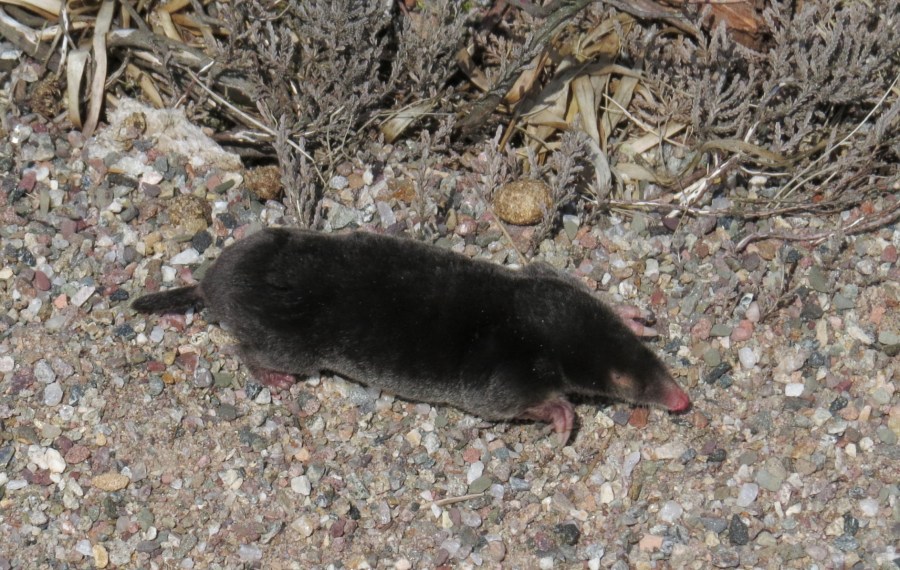
Male moles should now be off searching for mates. April is the month when moles’ testicles are heaviest, say Gorman and Stone (1990: The Natural History of Moles). Moles are territorial and almost entirely solitary, only coming together to breed. In the mating season, a male begins to dig away from his territory in a straight line; his route will soon intersect with the territory of a female who may be receptive to him. If she were not, she would attack him, but it’s likely the male is able to smell the female’s condition before reaching her, so avoiding this risk. Moles have a high rate of pregnancy (known from dissections of summer specimens), hence these authors suspect that ovulation is induced by copulation.
Moles have unusual, two-part ovaries. The medullary ovary appears to be a source of testosterone, and for most of the year it prevails and female moles are hard to distinguish from males on the basis of genitalia. The other part, the ovarian ovary, will start to shed egg cells when the female comes into breeding condition. At this stage her vagina, previously sealed up, opens and she ceases to look masculine.
In March, it looked as though roebucks Capreolus capreolus were shedding the velvet from their antlers. Better sightings here at NJ517470 have shown that this wasn’t true, at least not in every case. But now, late in April, bony antlers are the rule. The velvet may not be all gone yet, however: a buck encountered in daylight (23 April) appeared to have dark, thick antlers, as though still covered, while his coat was a handsome blend of brown and dark grey.
In spring, female pine martens Martes martes seem to have little or no fear of humans. When met in daytime, the martens act cautious but basically unconcerned. Their being females has been inferred from encounters where the marten was holding a baby by the scruff of its neck. Also, females are not as large as males; when viewing long sequences of photos the small differences between individuals become familiar.
Individual pine martens can be recognised from variations in the shape of the lighter throat patch. But observations at NJ516470 are not as sophisticated as that. Presumably, the same mother martens may last a season or two (they are said to breed in their second year), but it’s not possible to claim that today’s mother is the same one seen moving her brood in an earlier year. So although they might seem to make a habit of hauling half-grown young into the workshop roof in May, there’s always a chance that in some spring a new female will give birth there.
There are young martens in the roof at present. They can be heard growling softly and grumbling among themselves. They might have been born in there, or their mother may have brought them in from elsewhere. Although she was seen near the workshop a couple of weeks ago, she wasn’t holding a baby; at that stage the presence of kits was only suspected, due to a faint, sweetish odour reminiscent of newborn kittens. This could have been imaginary. Besides, there are plenty of smells in an old stone building.
Annie Lamb
Annie is a zoologist and wildlife recorder. She has run a camera trap in the region for the past ten year.
 North East Scotland Mammal Network