In our part of the world, spring happens quickly. Every day there’s growth and change. Young mammals, born in earlier months, begin to appear in the open. Others are being born now, while for some species it’s only just mating time. May is a busy month.
Pine Marten
The pine marten Martes martes who had babies in the shed roof continues to care for them there. At times they can be heard scuffling and squealing. Outside, under the hole where their mother goes in and out, feathers and blowflies show that prey is being brought in. The mother has been seen emerging at sunset, and probably she is the marten who most often appears on the nearby trail camera. There are two adults on most nights, one with a full-furred tail, the other with a chunk of hair missing from the tip—the kind of accident that happens to mothers.
By 20 May the little martens are big enough to explore the building below the roof, knocking things about and fouling the floor. One of them was seen squirming in the entrance hole. Its mother had it by the scruff and might have been hauling it to safety; she might have been planning to move them, however, when interrupted. There’s no telling how many babies she has. Perhaps there’s just one. She (or some other female) has had more in the past. ‘Two parents make two parents’, we’re told, so, sadly, some of the litter are lost over time.
Red Fox
Young red foxes Vulpes vulpes should be leaving their earths by now and playing outside. National Fox Welfare’s web site remarks that when people see cubs in the daytime, often they think that the vixen has abandoned them, since there’s no adult fox in sight. But, at this stage, as they explain, the vixen tends to leave the cubs for much of the day. She will make brief visits, bringing small meals for them. National Fox Welfare suggest that concerned observers should leave an egg a few feet from the earth (don’t go too close) and check later to see if it’s disappeared. If it has, the vixen has taken it, so the cubs are not abandoned. This test is predicated on the idea that only an adult fox would be able to pick up the egg, unless there are badgers Meles meles about. In this neighbourhood, there are plenty. An egg might also be taken by a pine marten (famously able to manage osprey eggs), or by some corvid.
In the recent British Wildlife magazine a red fox is mentioned in Wildlife Reports. It stowed away on a freighter from England, and was discovered when it landed in the States. ‘Animals can end up far outside their normal ranges,’ the report says. But were there not always red foxes in North America?
It turns out that the taxonomic status of New World red foxes is debatable. Europeans knew they were there from early times (the fur trade being one reason to annex the continent) and modern Americans see them as part of the fauna. To complicate matters, English red foxes have been released there on occasion. www.wtwo oronline.me.uk/questions/answer/are-north-american-and-european-red-foxes-different-species gives an account in depth of how taxonomists have looked at the Old World and New World foxes, sometimes lumping them together, sometimes splitting them into two, or classing them as subspecies. A definitive answer may be moot, as it more or less depends on whose answer it is.
According to the British Trust for Ornithology, the fox population of this country has decreased dramatically since last century. This is surprising since we hear nowadays of so many foxes in cities. The NESBReC species distribution map https://nesbrec.org.uk/biomaps shows dense concentrations of sightings round Aberdeen and numerous sightings out with town too, but it’s true they become a little sparser if filtered for recent years. In looking for trends in records like these, we should make allowances for numbers of observers (there are more human beings in the city) and for the eagerness with which they send records in (a fox in the town is rather exciting). But these confounding factors are probably constant, year on year. So, our area fits with the BTO’s assertion: there are fewer foxes than there used to be.
Foxes are not legally protected as so many carnivores are. They must not be subjected to unnecessary suffering (how much is that?), and strictly not hunted with dogs, but you may kill them, and in order to protect other animals, people do. There are still foxes on the Sands of Forvie. That’s in spite of Scottish Natural Heritage (as it was) making the decision to undertake ‘targeted control’ of foxes on the reserve. This was a good many years ago, when it was clear that foxes and crows, also targeted, were overwhelming the nesting terns and eider. But many of us remember when a stroll round Forvie would take us past foxes’ earths, and also, we’d see a lot of rabbits Oryctolagus cuniculus. Those should keep the foxes fed, whatever the season. The sands may still be a good place to look for cubs at play.
Walrus
Everywhere in the news is Magnus, a young walrus Odobenus rosmarus. The Press and Journal ran a Saturday sermon about him. He has been seen around Orkney, and at Hopeman, Fraserburgh, Macduff, Lossiemouth and Findochty, mostly during April. But he continues to be mentioned. Magnus may be the same walrus who came to the attention of British Divers Marine Life Rescue when he turned up in Fife, injured, back in the winter. But British Wildlife notes that lately, walruses are increasingly straying from their usual Arctic waters, with sightings in Norway and other northern countries.
It’s worth asking why they might do this. Magnus is not yet of breeding age, and besides, breeding brings walruses together ‘in the thousands’ (Animal Diversity Web). Hence it’s not sex that makes them roam; perhaps it has to do with food. Walruses prey on soft-shelled clams, such as Mya arenaria, searching the substrate for them using the whiskers. The web site polar-latitudes.com describes the manner of eating clams: once the walrus has them in its mouth, it crushes the shells, then sucks out the meat. It will eat steadily for 73 hours we’re told and consume 7000 clams. This is during ‘the peak clam season’ (a period that is nowhere actually defined). So, there are times when walruses don’t eat clams. They hunt seabirds and marine mammals, as well as trawling for benthic invertebrate prey.
Presumably walruses haul out to snooze on the dockside after eating—polar-latitudes.com says that having filled up on 7000 clams, they go to sleep for a day. It seems as though Magnus and other strays must be foraging with some success. But why do it down here? Has the Arctic a shortage of clams? But these journeys could well have some other object. Meanwhile, Magnus has left us and was sighted this month in Norway.
Roe Deer
Roe deer Capreolus capreolus give birth in May to from one to three small, spotted kids. Most folk know not to touch the kids when they find them. Until they grow big enough to accompany their mother, she leaves her young to lie hidden and still, protected from predators by camouflage, and by having almost no scent. Carnivores should not notice the russet coats that, to primate eyes, contrast sharply with the green vegetation around them.
Like the fox cubs, the roe kids may look as if their mother has left them—she could even be dead, so people are often tempted to take one home. But like the vixen, unless she really is dead, she’s coming back. She will suckle her kid and then move it to lie up somewhere else, says the web site www.aboutdeer.com. All will be well, unless some human interferes, perhaps going too close to the kid or even touching it and so leaving an alien scent; then the mother might actually desert it. We are advised to keep away, keep our dogs away and remember that although baby deer can be bottle-fed, hand-reared youngsters are unlikely to survive in the wild.
The kids born this month are the products of last summer’s rut. Implantation of the fertilised egg is delayed until January, after which comes a five-month gestation. The roe deer rut is a lively time, when you may meet a buck and doe running rings and figures of eight and paying you no attention. The buck is supposed to be in pursuit but the circular path they take makes it hard to be sure which is the pursuer.
Sources including the British Deer Society tell us that this behaviour occurs in July and August. In contrast, around here and elsewhere, it has been seen consistently in May and June. The sources are presumably not wrong (although they tend to copy each other), so perhaps the timing of the rut is changing. Apparently, this is happening with red deer Cervus elaphus, who usually also give birth in early summer. According to Dr J Langbein (bds.org.uk/2024/03/21/are-deer-birthing-seasons-changing-uk), a trend has been noted lately for earlier births among red deer on the Isle of Rum (Moyes et al, 2011). In England, the spread of birth dates is growing in both directions, with calves in the West Country being born not only in spring, but in autumn and winter. The spread of dates for the rut has changed in the same way, so that it now starts early and finishes late. Fallow deer Dama dama births and matings have shown the same trend.
Dr Langbein suggests that with milder mean temperatures, the deer are not losing body condition as winter advances, as they used to do. Instead, they are gaining it. For the growing young females this means they may reach breeding weight in the middle of winter, and ovulate, bringing on an extension of the autumn rut.
Milder winters are sure to affect roe deer along with the other species. Presumably starvation is rarer when conditions are not so hard, and new grass and browse should emerge earlier. As data come in, the BDS Deer Birth Dates Survey should be able to show how roe deer have been responding to temperature change. Meanwhile, if past experience means anything, we should watch out for deer enjoying their mating dance.
Orkney Voles
Orkney voles Microtus arvalis orcadensis and stoats Mustela erminea are in the news this month for unfortunate reasons. Stoats are not native to Orkney but arrived there in 2010 and found a rich source of food in the voles and seabirds. They became established very quickly on Mainland and southerly islands.
On Orkney, the voles are the only small mammals active by day. This makes them crucial to the survival of raptors that hunt in daylight. Stoats thus have an impact on these birds and on ground-nesting species that they predate directly. The Orkney Native Wildlife Project, basically an alliance for ridding Orkney of stoats, have monitored the voles and stoats since 2019 and in 2021 found the den of a stoat where hundreds of dead voles were cached.
The project’s elimination programme was a great success, removing 8,500 stoats between 2019 and last year. The populations of voles and birds have shown good signs of recovery. But in April (reported by the BBC this month), a stoat appeared on Rousay, where there were none before. This could be the start of a new round of problems.
If they have just the one stoat, ONWP’s detection dogs should soon find it. On the other hand, the appearance of one animal suggests that there could be more. And the singleton could be a female, in which case it may well be pregnant. This is the breeding season, and stoats are very fast breeders: the ONWP’s spokeswoman tells us that, in under ten years (2010 – 2019) since invading Orkney, stoats had occupied 58,000 hectares. The rapid increase is expected, given that stoats had no serious predators, few competitors, and unlimited food on Orkney. But its reproductive biology will have helped as well. Thanks to delayed implantation, female stoats breed from infancy, impregnated by a male who arrives in their mother’s den soon after their birth to mate with her. By the following year, when implantation takes place, these females will have grown big enough to sustain gestation. The mother stoat has between six and 12 young at a time; that might mean three to six females per litter, all pregnant before they can even see.
Hedgehogs
Hedgehogs Erinaceus europaeus have been active for at least a month. Now, in May, they should be in the midst of their rut. They are also in the news; the BBC (www.bbc.co.uk/news/articles/c202g60qrlpo) reports a study at Cambridge using artificial intelligence to map hedgehog habitat, and to predict where habitat may be lost to future development.
The study also addresses connectivity in their habitat. To have a rut the hedgehogs need to move about, seeking partners. Much has been written describing hedgehog biology and courtship: for example www.wildlifeonline.me.uk/animals/article/european-hedgehog-breeding-biology-mating-gestation is very informative. The dramatic word ‘rut’ seems fitting, partly because of the males’ persistence in the face of coyness, and partly because it’s all so noisy. Hedgehogs snort and grunt a lot, which partly explains their name. But dedicated observers distinguish between ordinary snorts and the rhythmic so-called ‘huffing’ that accompanies courtship.
This behaviour may carry on for some time. ‘Circling and huffing may continue for an hour or more’ (wildlife-online). Sometimes the male, or boar, must break off his wooing to challenge another male. Even if he has the sow to himself, she may simply stay face to face with him as he tries to get round behind her, hence the circling. Videos are often obtained in gardens where hedgehogs are fed. There, in order to get back to her food, eventually the sow will have to stop circling and let the male mount.
With luck, if we’re out at night and are quiet, we may hear hedgehogs snorting and huffing at one another. Then we might get a look at a pair. A bat-detecting foray is an opportunity. Hedgehogs may live in unexpected places, such as the badger-haunted terrain of Ruthven where at least one hedgehog sometimes appears.
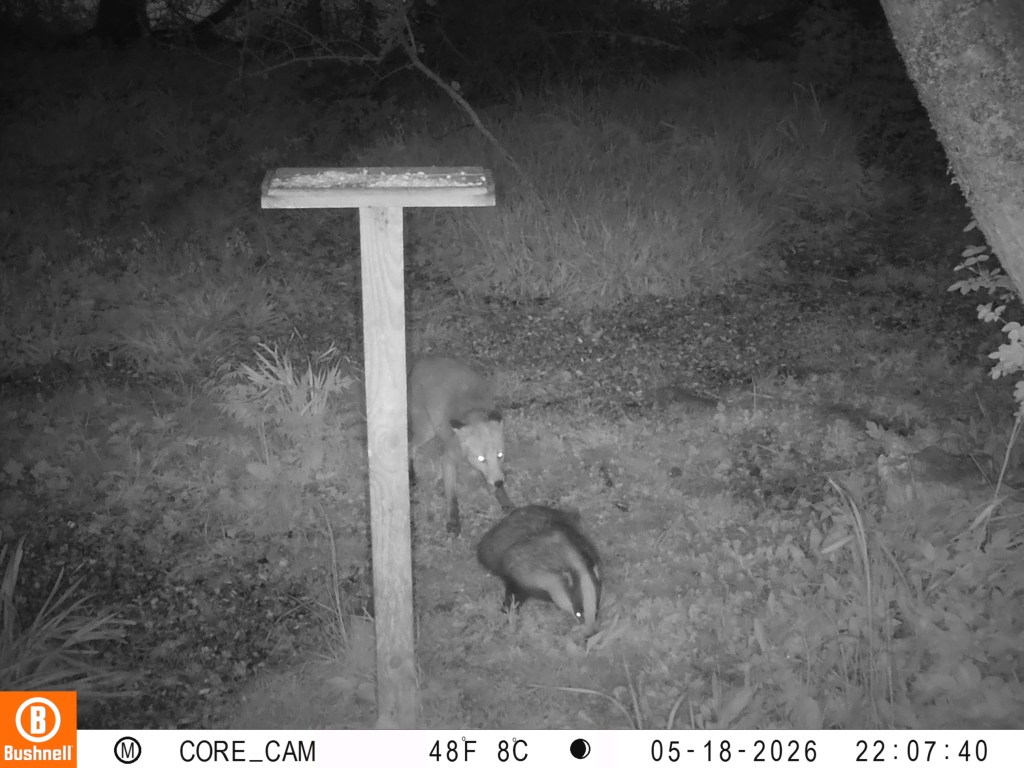
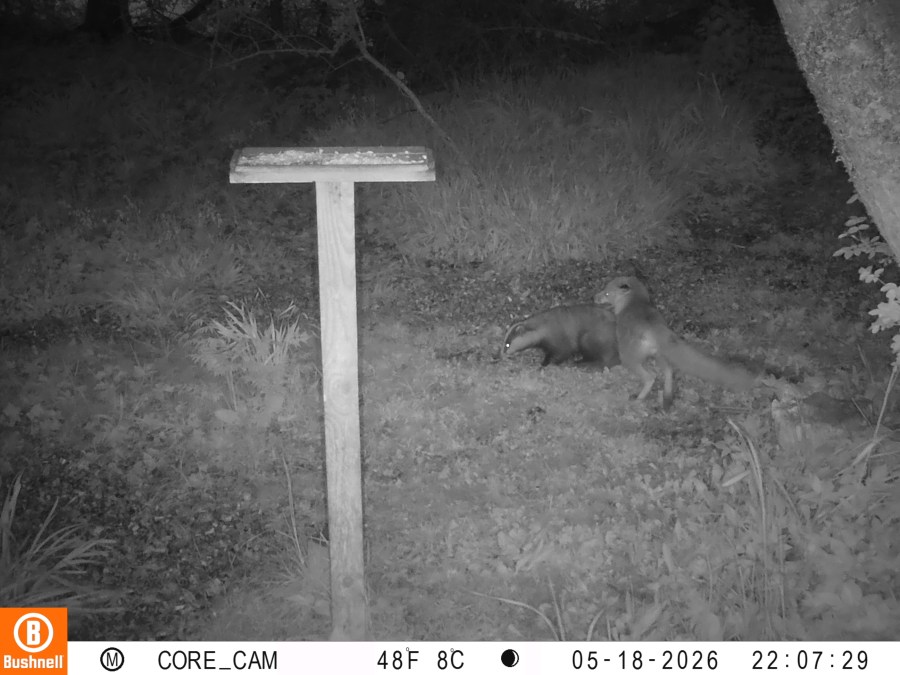
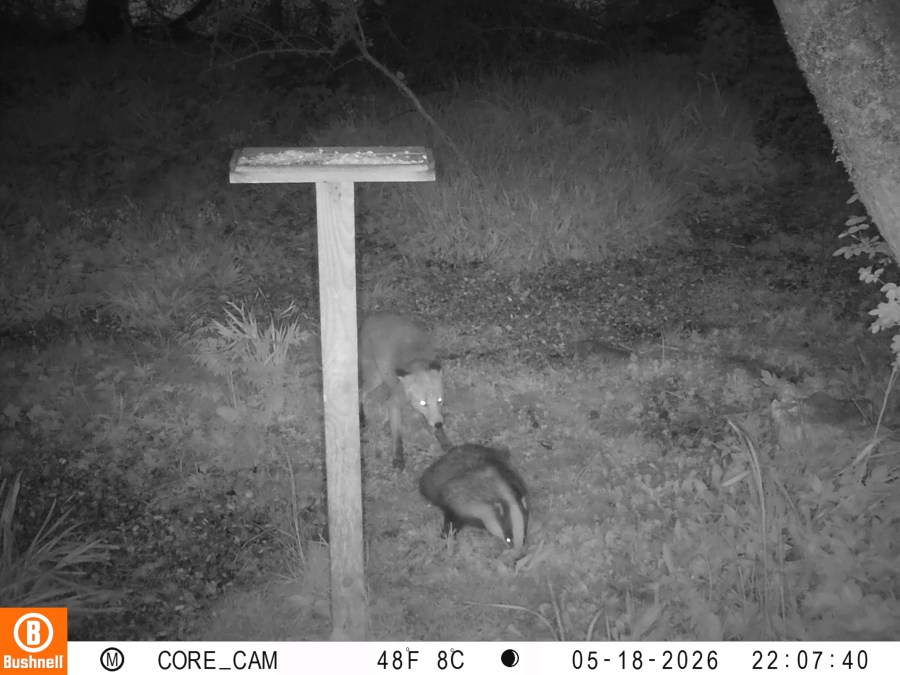
In fact, on a recent evening bat hunt, loud grunts and snorts from the camera site drowned out the clicking of bats on the headphones. It was still twilight, so animals could be spied on. There was no hedgehog, but there was a badger, plainly visible, and some other animal in shadow. In the morning, the camera showed a fox harassing the badger; presumably the badger was making the sounds, as they are great grumblers. The two had encountered each other on camera before, when no one was listening in.
Annie Lamb
Annie is a zoologist and wildlife recorder. She has run a camera trap in the region for the past ten year.

